
A technical and editorial guide for architects, façade consultants, developers, and project managers across the GCC
Sunscreen cladding: Across the UAE and wider GCC, building façades face a daily onslaught: sustained ambient temperatures exceeding 45°C, intense solar irradiance often surpassing 1,000 W/m², coastal salinity, desert dust infiltration, and relentless UV degradation. For architects, façade consultants, and developers, specifying a cladding system that simultaneously manages solar gain, preserves aesthetic integrity, satisfies energy efficiency mandates, and endures the region’s extreme climate is among the most demanding design challenges of any project—residential or commercial.
Sunscreen cladding systems have emerged as a highly effective response to these conditions. When correctly designed as part of a ventilated façade assembly, sunscreen cladding delivers measurable solar shading, reduces cooling loads, enhances building envelope performance, and introduces a layer of architectural expression that can define the identity of a development. For villas, residential compounds, mixed-use towers, and hospitality assets across Dubai, Abu Dhabi, Riyadh, Doha, and Muscat, the specification choice matters enormously.
This technical guide examines how sunscreen cladding systems work, why the UAE and GCC climate makes them indispensable, and how two premier product families— PARKLEX PRODEMA natural wood veneer cladding and WOODN innovative WPC composite profiles—represent best-in-class solutions for sunscreen and ventilated façade applications throughout the region.
What Are Sunscreen Cladding Systems? A Technical Definition
A sunscreen cladding system is an exterior façade assembly in which an outer cladding layer—whether solid panels, louvres, brise-soleil profiles, or perforated screens—is positioned proud of the primary building skin to intercept direct solar radiation before it reaches the main wall or glazing. This outer screen is typically mounted on a sub-structure of aluminium or stainless-steel brackets, creating an air cavity between the screen and the structural wall.
Within the context of ventilated façade technology, the sunscreen layer serves multiple simultaneous functions: it acts as a solar radiation barrier, a thermal buffer, a visual screen, and an acoustic dampener, while the ventilated cavity behind it facilitates the stack effect—drawing hot air upward and out of the system, reducing heat transfer through the wall assembly.
What is a sunscreen cladding system?
A sunscreen cladding system is an outer façade layer—using panels, louvres, or composite profiles—mounted proud of the main building wall on a ventilated sub-structure. It intercepts solar radiation, reduces heat transfer, and lowers cooling loads, making it a key energy efficiency strategy in hot climates such as the UAE and GCC.
Key Structural Components of a Sunscreen Cladding System
- Primary cladding panels or louvre profiles (the sunscreen element)
- Ventilated air cavity (typically 40–150mm depending on design intent and thermal performance targets)
- Thermal insulation layer bonded or mechanically fixed to the structural wall
- Weather-resistive barrier (where applicable)
- Structural substrate: concrete, masonry, or light-gauge steel framing
- Sub-structure: aluminium T-profiles, brackets, and fixing rails engineered to resist thermal movement and wind load
Why Sunscreen Façades Are Critical in UAE and GCC Conditions
The UAE & GCC Climate Challenge for Building Envelopes
The Arabian Peninsula presents a convergence of climatic stresses that few regions in the world match. Solar irradiance levels in Dubai and Riyadh regularly peak between 950–1,050 W/m², compared to European averages of 600–800 W/m². Ambient temperatures in summer months routinely exceed 40°C, with effective radiant temperatures at unshaded surfaces reaching 70°C or higher. Relative humidity in coastal cities such as Abu Dhabi and Doha oscillates between arid extremes in winter and near-saturated conditions in summer, creating a dual-stress environment for any building material.
For building envelopes, this translates into severe cooling loads, rapid material degradation from thermal cycling, UV-induced discolouration and cracking, and structural fatigue from daily thermal expansion and contraction. Without an effective sunscreen strategy, even high-performance insulation can be rendered inadequate—solar radiation absorbed by a dark or exposed cladding surface can elevate wall surface temperatures to levels that overwhelm insulation values.
Regulatory and Standards Context in the UAE & GCC
The regulatory environment increasingly mandates performance-based façade design. The UAE’s Estidama Pearl Rating System (Abu Dhabi), Dubai Green Building Regulations (DGBR), and the LEED certification framework widely adopted across GCC projects all include explicit requirements for solar shading coefficients, building envelope thermal transmittance (U-value), and cooling energy intensity. Saudi Arabia’s Saudi Building Code (SBC) similarly mandates energy performance benchmarks for commercial and residential envelopes. Sunscreen cladding systems are among the most efficient technical tools available to achieve compliance with these frameworks while maintaining architectural quality.
Residential Buildings and Villas: The Case for Sunscreen Cladding
While sunscreen façades have long been associated with commercial towers and institutional buildings, the residential sector—particularly villa developments, low-rise residential compounds, and luxury apartment buildings—represents one of the fastest-growing application markets across the GCC. Villa developers and private homeowners in communities such as Emirates Hills, Al Barari, and NEOM’s residential districts increasingly demand façade systems that deliver privacy screening, solar shading, and design individuality simultaneously.
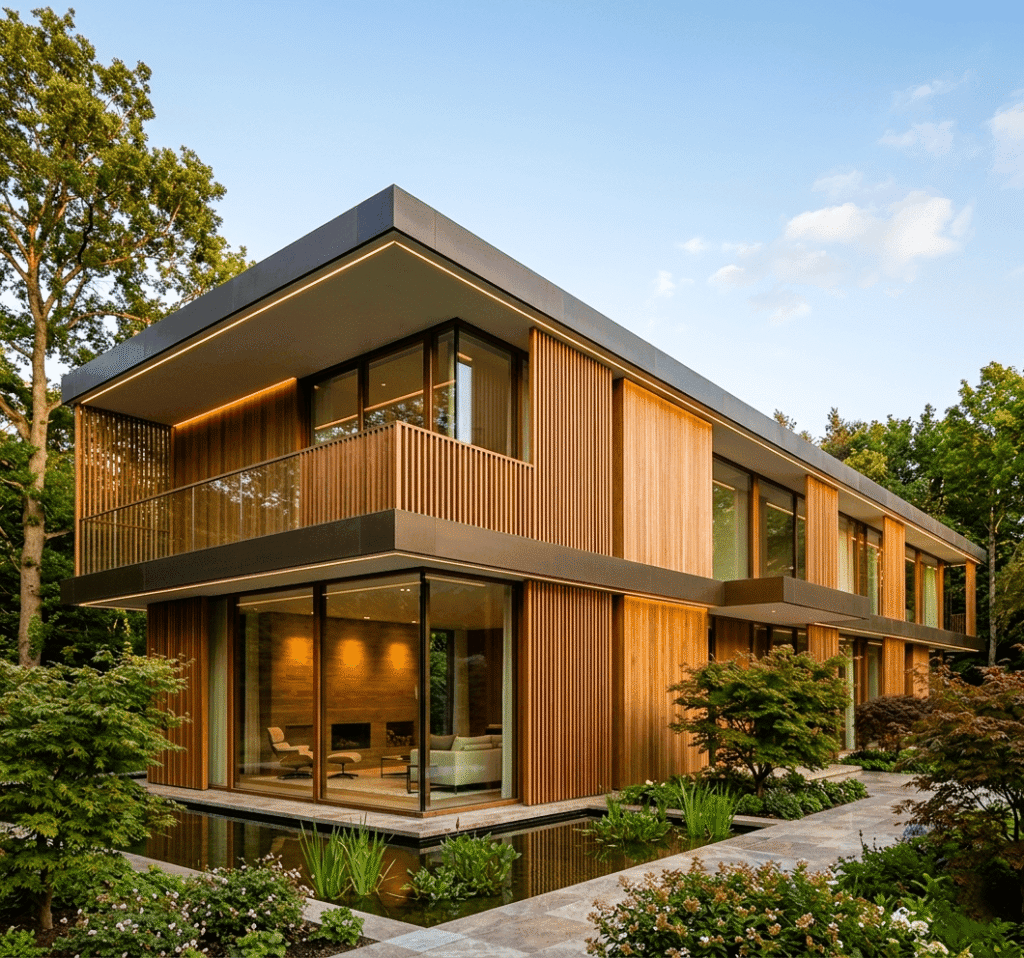
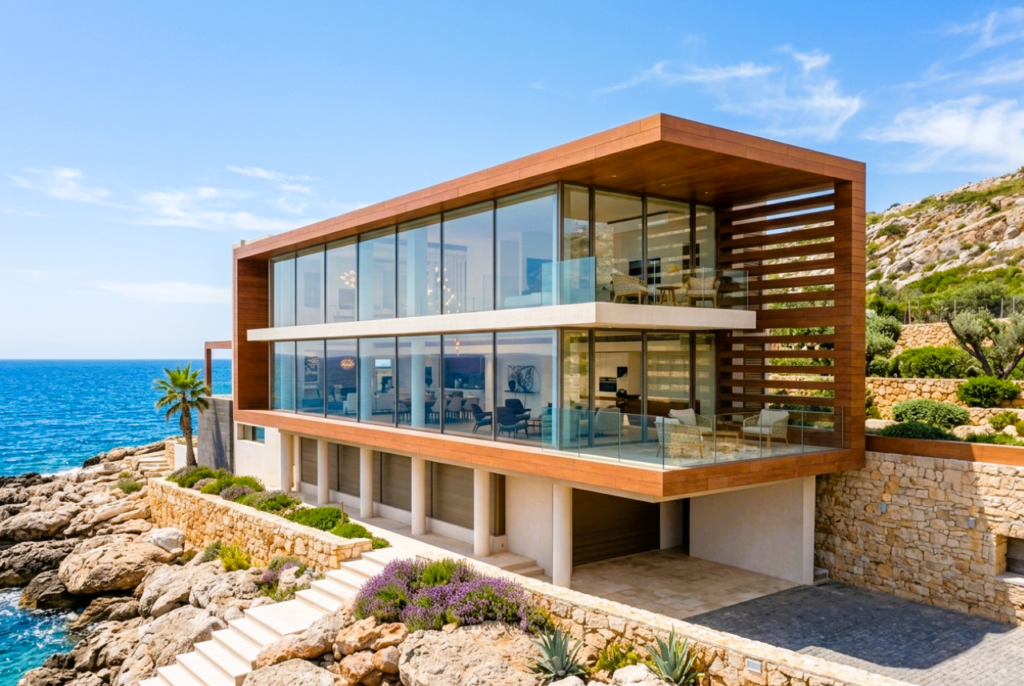
For villas, sunscreen cladding functions as an architectural veil: modulating light into interior spaces, creating dynamic shadow play on elevations, reducing HVAC loads in habitable rooms, and providing a contemporary or biophilic aesthetic that connects outdoor and indoor environments. PARKLEX PRODEMA‘s natural wood veneer panels and WOODN’s WPC louvre and pergola profiles are particularly well-suited to this context, offering warmth of material, design flexibility, and engineered performance for GCC outdoor exposure.
PARKLEX PRODEMA: Natural Wood Veneer Sunscreen Cladding for GCC Projects
PARKLEX PRODEMA is one of the world’s leading manufacturers of high-performance natural wood veneer panels engineered for exterior and interior cladding applications. Their panels are specified on landmark buildings across Europe, the Middle East, and Asia—and represent a benchmark in the fusion of natural materials with engineering rigour. OBRAS International is the authorised GCC supplier of PARKLEX PRODEMA products.
Product Technology and Construction
PARKLEX panels are manufactured through a thermosetting resin impregnation process: natural wood veneers from sustainably managed forests are bonded to high-density phenolic resin core substrates under heat and pressure. The result is a panel with the visual warmth and natural variation of real wood, but with a performance profile that includes high resistance to UV radiation, moisture absorption, thermal cycling, and biological degradation.
The exterior surface of PARKLEX panels is treated with Parklex’s proprietary UV-stable finishing system, which maintains colour consistency and natural wood character even after prolonged exposure to direct GCC sunlight—a performance characteristic that distinguishes them from standard timber or standard HPL alternatives.
Sunscreen Applications: Panels, Louvres, and Brise-Soleil
PARKLEX PRODEMA’s panel range is versatile enough to be fabricated and installed in multiple sunscreen configurations:
- Horizontal or vertical louvre arrays, mounted in front of glazed curtain walls or spandrel zones to create effective solar shading angles tailored to site latitude and orientation
- Full-elevation sunscreen screens with perforation or open-joint detailing to allow diffuse light and ventilation while blocking direct solar radiation
- Brise-soleil elements over windows and glazed openings in residential villas and apartment buildings
- Cladding panels combined with open-joint ventilated façade assemblies to form integrated thermal and aesthetic envelopes
Climate Performance in UAE & GCC Conditions
PARKLEX panels are certified for exterior use in demanding climates and carry classification under EN 13501-1 (Euroclass B-s2, d0 in standard configurations), which satisfies UAE fire safety requirements for medium and high-rise façade applications. Their low moisture absorption coefficient (< 1% by mass) makes them highly suitable for the humidity fluctuations characteristic of coastal GCC cities. Thermal expansion coefficients are managed through open-joint installation details and appropriate bracket engineering, ensuring dimensional stability across the full GCC temperature range.
PARKLEX PRODEMA in GCC Residential Projects — Key Specification Points
- Available in over 20 natural wood species including Teak, Iroko, Oak, Wenge, and Afrormosia — suitable for both contemporary and traditional GCC villa aesthetics
- Panel dimensions up to 3,100 x 1,300mm — allowing large, seamless elevations with minimal joint interruption
- Euroclass B fire rating — compliant with UAE Civil Defence requirements for external cladding
- Colour stability: minimum 10 years UV resistance validated under accelerated weathering testing
- Compatible with OBRAS International’s full ventilated façade sub-structure systems
Available in horizontal, vertical, and angled configurations for maximum solar shading flexibility
WOODN: WPC Composite Profiles for Sunscreen, Louvres, Pergolas & Ceilings
WOODN is an Italian innovator in Wood-Plastic Composite (WPC) profiles, offering a range of sunscreen louvres, pergola systems, ceiling profiles, and cladding elements that combine the visual warmth of timber with the mechanical and weathering performance of engineered composites. As an OBRAS International product partner, WOODN is available for specification across UAE and GCC residential and commercial projects.
WPC Material Science: Why It Performs in the GCC
Wood-Plastic Composites used in WOODN products are manufactured by co-extruding wood fibre (typically 50–70% by composition) with thermoplastic polymers—primarily high-density polyethylene (HDPE) or polypropylene. The result is a dense, stable profile that resists moisture absorption, biological attack (including termite and fungal degradation—a consideration in humid GCC coastal environments), UV-induced colour fade, and thermal deformation at the operating temperatures typical of UAE summers.
WOODN’s proprietary surface finish technology produces profiles that closely replicate the texture and grain of natural wood, available in a range of tonal finishes from pale ash and honey teak to deep charcoal and espresso—enabling architects to achieve a biophilic design aesthetic appropriate to villa, resort, and residential compound projects without the maintenance demands of natural timber.
WOODN Sunscreen and Solar Shading Applications
- Louvre Systems: WOODN’s louvre profiles are engineered for horizontal and vertical sunscreen arrays in front of glazed elevations, pergola structures, carports, and exterior corridors in villa and hospitality settings. The profiles are available in fixed and adjustable configurations.
- Pergolas: WOODN pergola systems integrate structural and aesthetic sunscreen functions—providing overhead solar shading for terraces, pool areas, and landscaped courtyards in residential villas and mixed-use projects. The WPC construction eliminates the maintenance and discolouration issues associated with natural timber pergolas in GCC outdoor environments.
- Ceiling Profiles: Used in external covered walkways, soffits, and transitional indoor-outdoor spaces, WOODN ceiling profiles introduce natural warmth while providing structural ventilation slots that maintain air movement in UAE’s heat.
- External Cladding: WOODN WPC cladding profiles can be specified as sunscreen layers in combination with structural substrates, delivering a wood-effect exterior face with zero painting, sealing, or oiling requirements—a significant lifecycle advantage in GCC markets where maintenance costs and access restrictions in occupied developments are a constant challenge.
Performance Credentials for UAE & GCC Exposure
WOODN products carry third-party certification for exterior use including UV resistance testing aligned to EN ISO 4892-2, moisture resistance testing under EN 15534, and fire performance classification. For GCC villa and residential specifications, the maintenance-free performance claim is particularly compelling: no repainting cycles, no anti-fungal treatment requirements, and no cracking or splitting associated with natural timber in extreme thermal cycling environments.
WOODN WPC — Specification Advantages for UAE Villas and Residential Projects
- Zero maintenance: no painting, sealing, or oiling — major lifecycle cost advantage in occupied GCC developments
- Resistance to UV fade, moisture, and biological degradation across the full GCC climate range
- Available in louvre, pergola, ceiling, and cladding profile configurations — enabling complete outdoor envelope solutions from a single system
- Fire performance classification available for UAE Civil Defence compliance
- Compatible with OBRAS International ventilated façade sub-structures and architectural hardware
Wood-effect finishes in contemporary tones suited to modern and heritage-inspired GCC villa aesthetics
Sunscreen Cladding and Ventilated Façade Integration: The Technical Framework
The full performance potential of sunscreen cladding is realised when it is specified as part of an integrated ventilated façade system—not as a standalone decorative element. For architects and façade consultants working on UAE and GCC projects, understanding the thermal physics of the ventilated assembly is essential to making accurate performance claims in design submissions, energy modelling, and regulatory compliance documentation.
The Stack Effect and Thermal Cavity Dynamics
In a ventilated façade assembly, solar radiation is absorbed by the outer cladding face (the sunscreen layer). The absorbed heat warms the air in the cavity between the screen and the insulated structural wall. Buoyancy drives this warmer air upward and out of the cavity through open joints at the top of the façade, drawing cooler air in from the bottom. This continuous air movement—the stack effect—significantly reduces the quantity of heat transmitted through the wall to the interior, supplementing the performance of the insulation layer in ways that static façade assemblies cannot replicate.
Computational fluid dynamics (CFD) studies and in-situ monitoring of ventilated façade assemblies in hot climates have demonstrated that effective ventilated cavity design can reduce wall surface temperatures by 8–15°C compared to equivalent non-ventilated assemblies, directly reducing cooling energy demand and extending material service life by limiting peak thermal stress on adhesives, brackets, and panel substrates.
Solar Shading Coefficients and Orientation Strategy
For sunscreen louvre arrays, the solar shading performance is primarily a function of louvre angle, depth, spacing, and façade orientation. In GCC latitudes (approximately 22°N–26°N for the UAE), south-facing façades receive the highest cumulative solar radiation over the year, while west-facing elevations are subject to the most intense afternoon sun at the highest ambient temperatures—creating the most critical envelope performance scenario. East-facing façades face morning sun exposure. North-facing façades in UAE latitudes receive significant oblique solar radiation on summer mornings and evenings.
Parametric analysis tools such as Autodesk Revit’s energy simulation extensions, IES VE, and DesignBuilder allow façade consultants to model louvre configurations with PARKLEX or WOODN profiles and calculate shading mask angles, Fc (shading factors), and projected annual cooling energy savings with reasonable accuracy at early-design stage.
Acoustic Performance in Residential Applications
For residential villas and apartments in urban GCC locations—adjacent to arterial roads, construction zones, or aviation flight paths—ventilated sunscreen cladding also provides measurable acoustic attenuation. The outer cladding screen, air cavity, insulation layer, and structural wall together function as a multi-mass acoustic barrier. PARKLEX PRODEMA panels and WOODN profiles both contribute to the overall acoustic mass of the assembly.
Energy Efficiency, Sustainability, and Green Building Compliance
Contribution to UAE Estidama and DGBR Compliance
The UAE’s Estidama Pearl Rating System (administered by Abu Dhabi Urban Planning Council) awards credits for reduction of cooling energy intensity, solar heat gain coefficient (SHGC) control, and envelope thermal performance. Sunscreen cladding systems directly address the Pearl Energy Credit PE-R1 (Optimise Energy Performance) through demonstrable reduction of solar heat gain. Similarly, Dubai Green Building Regulations Category 5 (Energy) includes mandatory minimum shading requirements for glazed areas in new buildings that sunscreen cladding systems can satisfy when designed to appropriate shading coefficients.
Material Sustainability: PARKLEX PRODEMA and WOODN
PARKLEX PRODEMA sources veneers from sustainably managed forests, and several wood species are available with FSC (Forest Stewardship Council) chain-of-custody certification—a requirement increasingly mandated by developers pursuing LEED Gold or Platinum certification on GCC projects. The thermosetting resin construction of PARKLEX panels also contributes to material longevity, reducing lifecycle replacement cycles and associated embodied carbon.
WOODN WPC profiles utilise a significant proportion of recycled or reclaimed wood fibre and polymer content, positioning them within circular economy product categories recognised by LEED Material and Resources credits. Their maintenance-free performance profile further reduces operational embodied carbon—no solvent-based coatings, no replacement cycles within normal building service life.
Life Cycle Analysis Considerations for GCC Façades
When conducting lifecycle analysis (LCA) for GCC façade specifications, the combination of high solar irradiance (accelerating degradation in lower-performance materials), high cooling energy costs, and the relatively short speculative development cycles common in Gulf real estate markets makes material durability and maintenance cost disproportionately important. Both PARKLEX PRODEMA and WOODN products are engineered to 20–30 year service lives under GCC exposure conditions—a specification argument that resonates with developers, project financiers, and government asset owners alike.
Fire Safety Compliance for External Cladding in the UAE
Following the UAE Federal Authority for Government Human Resources’ post-Grenfell review of external cladding fire safety, the UAE’s Ministry of Interior and Dubai Civil Defence issued updated technical circulars tightening fire performance requirements for all external cladding materials on buildings above 15 metres in height. The classification framework broadly aligns with EN 13501-1, requiring Euroclass A2 or B minimum performance for external cladding on high-rise and medium-rise buildings.
PARKLEX PRODEMA panels are available in Euroclass B-s2, d0 classification, which satisfies UAE Civil Defence requirements for the majority of mid-rise residential and commercial buildings. For buildings where A2 classification is required, OBRAS International and the project’s façade consultant should engage with PARKLEX’s technical team to specify appropriate substrate and core configurations that achieve the required classification. WOODN WPC profiles carry fire performance certification; specific classification data should be verified with OBRAS International for project-specific compliance documentation.
Fire Safety Note for GCC Specifiers
- Always confirm EN 13501-1 classification requirements with UAE Civil Defence or the relevant emirate/country authority for the specific building height, use, and location
- Request product-specific fire test certificates (not generic technical data) when submitting for building permit or Civil Defence NOC
OBRAS International can provide PARKLEX PRODEMA and WOODN fire performance documentation and support material submission to regulatory authorities
Design Versatility: Applications Across GCC Building Typologies
Luxury Villas and Private Residences
In the GCC’s premium villa market—spanning developments in Dubai’s Jumeirah, Palm Jumeirah, Emirates Hills, Abu Dhabi’s Saadiyat Island, and Saudi Arabia’s Diriyah and Red Sea developments—sunscreen cladding serves as a primary architectural design element as much as a functional performance system. PARKLEX PRODEMA’s natural wood veneer panels introduce organic texture and warmth to contemporary concrete and glass villa elevations, while WOODN louvre and pergola systems create layered façade compositions with strong shadow play that enhances the visual depth of the building envelope.
Residential Compounds and Mid-Rise Apartments
For mid-rise residential compounds and apartment buildings—a dominant typology in Dubai’s JVC, Business Bay, Al Reem Island, and comparable GCC locations—sunscreen cladding systems offer a cost-efficient means of differentiating the façade design, improving energy performance, and creating visual continuity between building clusters within a masterplan. WOODN’s WPC louvre profiles in particular offer a scalable, repetitive sunscreen element that can be deployed across multiple building elevations within a development with consistent detailing and predictable performance.
Hospitality, Resort and F&B Projects
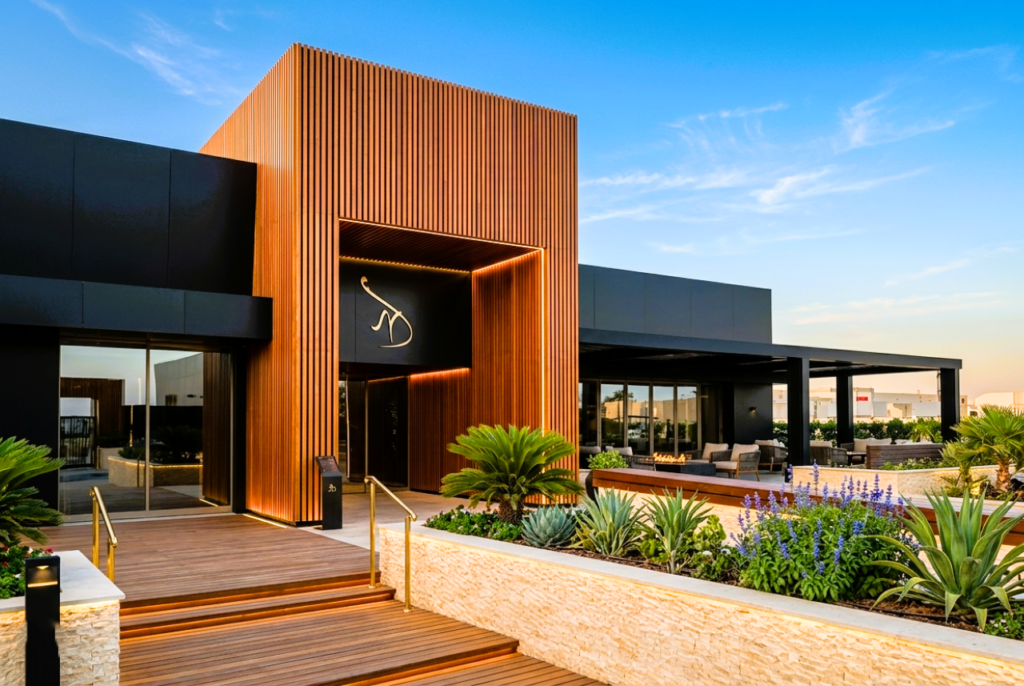
The Gulf’s hospitality development pipeline—encompassing resort hotels, branded residences, beach clubs, and F&B concepts—consistently demands façade systems that deliver authentic natural material aesthetics at commercial performance and maintenance standards. PARKLEX PRODEMA’s teak, iroko, and oak veneer panels are regularly specified for hotel room corridor screens, pool deck privacy screens, and restaurant terrace cladding in UAE and Saudi hospitality projects, precisely because they combine the warmth of real wood with a durability profile that satisfies asset owners’ operational requirements.
Commercial and Mixed-Use Developments
In commercial offices, retail podiums, and mixed-use towers—where façade specifications carry significant procurement volume and are subject to rigorous engineering review—PARKLEX PRODEMA’s certified performance data and WOODN’s third-party tested WPC profiles provide the technical documentation depth required by façade consultants, MEP engineers, and value engineering panels to retain premium cladding specifications through design development and procurement stages.
GCC Market Outlook: Sunscreen Cladding Demand Drivers (2024–2030)
The GCC construction market is entering a sustained phase of high-volume development activity driven by Saudi Arabia’s Vision 2030 giga-projects, UAE’s Centennial 2071 urban expansion agenda, and Qatar and Oman’s post-World Cup and tourism investment programmes. Several converging trends are accelerating the adoption of sunscreen cladding systems specifically:
- Tightening energy codes: UAE and Saudi Arabia’s progressive reduction of allowable building energy intensity is moving performance-based façade specification from premium to mainstream across all building typologies
- Biophilic design demand: Architects, developers, and end-users across GCC residential and hospitality markets are increasingly prioritising natural material aesthetics—creating ideal conditions for PARKLEX PRODEMA wood veneer and WOODN WPC product adoption
- LEED and Estidama mainstreaming: Green building certification is now a commercial expectation on major GCC developments, with sunscreen cladding contributing directly to envelope energy performance credits
- Post-Grenfell fire safety reform: Accelerating specification of classified cladding materials and systems with documented fire performance data, favouring manufacturers with established certification programmes
- Lifecycle cost focus: Increasing developer sophistication in whole-life cost analysis is favouring low-maintenance, high-durability façade systems over lower first-cost alternatives with higher operational cost profiles
- Giga-project scale: Saudi Arabia’s NEOM, Red Sea Project, Diriyah Gate, and Qiddiya involve unprecedented façade specification volumes, including extensive villa and resort residential programmes where sunscreen cladding is a design-led priority
Against this backdrop, OBRAS International’s positioning as the GCC’s specialist ventilated façade materials partner—with access to PARKLEX PRODEMA and WOODN’s full product ranges, supported by technical expertise, sample libraries, and regional project references—provides architects, consultants, and developers with a uniquely comprehensive resource for sunscreen cladding specification.
What is sunscreen cladding and how does it differ from standard façade cladding?
Sunscreen cladding refers specifically to an outer cladding layer or screen designed and positioned to intercept solar radiation before it reaches the main building wall or glazing. Unlike standard flush-mounted façade cladding, sunscreen systems are installed proud of the building envelope—typically on a ventilated sub-structure—and may use louvres, open-joint panels, or perforated screens to block direct sun while allowing diffuse light and air movement. In UAE and GCC climates, this distinction is critical: a standard cladding system manages the aesthetics and weatherproofing of the envelope, while a sunscreen system actively reduces solar heat gain, lowers cooling energy demand, and extends the service life of underlying envelope components by shielding them from peak solar radiation.
Which sunscreen cladding material is best suited to UAE villa projects—natural wood veneer or WPC?
Both PARKLEX PRODEMA natural wood veneer panels and WOODN WPC profiles are technically validated for UAE exterior exposure, and the specification choice depends on project-specific priorities. PARKLEX PRODEMA is the preferred choice where genuine natural wood character—grain variation, tactile warmth, and the premium feel of real wood species such as Teak or Iroko—is a design priority. WOODN WPC is the preferred choice where zero-maintenance performance is paramount—particularly in villa projects where the client or asset manager requires a façade that performs without periodic painting, sealing, or treatment interventions over a 20–25 year service life. Many villa projects in the GCC use both products: PARKLEX panels for primary elevations and feature screens, WOODN louvres and pergola systems for outdoor entertainment areas and poolside structures. OBRAS International can advise on the optimal combination for specific project contexts.
Do sunscreen cladding systems comply with UAE fire safety regulations for residential buildings?
Fire compliance for external cladding in the UAE is governed by UAE Civil Defence regulations and, in Dubai, by Dubai Civil Defence technical circulars that align with EN 13501-1 Euroclass fire classification standards. For residential buildings above 15 metres, external cladding materials are required to achieve a minimum Euroclass B classification (and A2 or better for higher-risk building types or heights). PARKLEX PRODEMA panels are certified to Euroclass B-s2, d0 in standard configurations, which satisfies UAE requirements for the majority of residential and commercial applications. Project-specific fire compliance should always be confirmed with the relevant Civil Defence authority, and OBRAS International can provide fire test certificates and support the submission process for building permits and NOC applications.
How much can a sunscreen cladding system reduce cooling energy costs in a UAE building?
Quantified energy savings from sunscreen cladding depend on building geometry, orientation, glazing ratio, internal loads, and the specific shading performance of the cladding configuration modelled. However, research and project-level energy simulation consistently indicates that effective solar shading—reducing solar heat gain through the envelope by 30–50%—can reduce annual building cooling energy demand by 10–25% for commercial buildings and 8–18% for residential buildings in UAE climatic conditions. In absolute terms for a medium-sized GCC villa with high glazing ratios and west-facing exposures, this can represent annual energy cost savings in the range of AED 8,000–25,000 depending on HVAC system efficiency and occupancy patterns. These savings compound over the building’s service life, making sunscreen cladding a sound investment alongside its aesthetic and compliance value.
Where can architects and façade consultants in the UAE specify PARKLEX PRODEMA and WOODN products?
OBRAS International is the exclusive GCC distributor and technical partner for PARKLEX PRODEMA and WOODN products, servicing projects across the UAE (Dubai, Abu Dhabi, Sharjah), Saudi Arabia, Qatar, Oman, Kuwait, and Bahrain. OBRAS provides specification support services including product sample supply, technical data sheets, BIM object libraries, project-specific detailing guidance, and quantity surveying assistance. The team works directly with architects, façade consultants, main contractors, and project managers from early design stage through to procurement and installation. Contact OBRAS International via the specification enquiry portal on the OBRAS website to initiate a project review.