
High-Performance Rainscreen Façade Design for Dubai, Abu Dhabi & GCC Projects
In 2026, ventilated façade systems in the UAE are no longer considered an optional architectural upgrade—they are now a core performance requirement for modern building envelopes across Dubai, Abu Dhabi, Sharjah, and the wider GCC region.
Driven by extreme climatic conditions, strict fire regulations, and aggressive sustainability targets, ventilated façade systems have become the preferred specification standard for architects, façade consultants, and developers working on commercial towers, residential developments, hospitality projects, and institutional buildings.
For high-performance architecture in the UAE, the façade is no longer just a visual layer. It is a functional environmental control system responsible for thermal regulation, moisture protection, energy efficiency, and long-term structural durability.
This comprehensive guide explains everything required to correctly specify ventilated façade systems in UAE and GCC projects—covering system composition, materials, regulations, performance advantages, design methodology, and specification risks.
What Is a Ventilated Façade System? (Rainscreen Façade Explained)
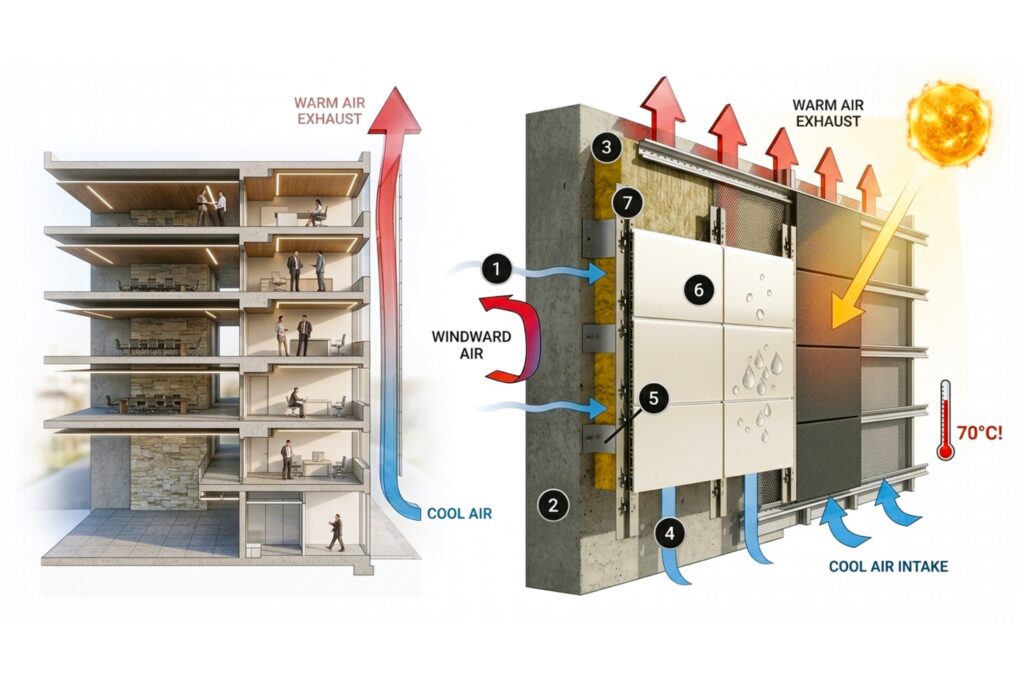
A ventilated façade system, also known as a rainscreen façade system, is a multi-layer external wall assembly designed to create a continuous air cavity between the external cladding and the building structure.
Typical Ventilated Façade Build-Up
A standard high-performance system includes:
- External cladding layer (e.g. fibre cement panels, Natural wood composite panels, Porcelain panels)
- Continuous ventilated air cavity
- Thermal insulation layer (rock wool or mineral insulation)
- Structural wall (reinforced concrete or blockwork)
This engineered cavity enables controlled airflow, which significantly improves thermal performance, prevents moisture retention, and enhances façade durability—especially critical in the UAE climate.
Why the Air Cavity Matters
The ventilated gap acts as a thermal buffer zone, reducing heat transfer from external surfaces into the building envelope. This directly reduces HVAC load, which is one of the highest operational costs in GCC buildings.
Core Principle of Performance
The ventilated cavity operates on a simple but powerful environmental principle:
- Heat rises and escapes through ventilation gaps
- Moisture evaporates instead of being trapped
- External heat is decoupled from internal structure
This creates a stable and controlled building envelope, especially important in extreme GCC climates.
Why Ventilated Façade Systems Are Essential in UAE & GCC Climate
The UAE climate presents one of the most demanding façade performance environments in the world.
Architects and consultants must design for:
- Extreme solar radiation intensity (year-round exposure)
- High ambient humidity in coastal cities
- Salt-laden air affecting façade durability
- Sandstorms and airborne particles
- High internal cooling loads due to HVAC dependency
Without ventilated façade systems, traditional cladding solutions often fail to manage these environmental stresses effectively.
1. Thermal Efficiency & Energy Reduction
By reducing heat transfer through the envelope, ventilated façades significantly lower HVAC energy consumption—supporting UAE Net Zero and sustainability targets.
This principle of heat exchange control reflects how enclosed air behavior impacts thermal performance in façade systems.
2. Moisture & Condensation Control
Air circulation within the cavity prevents:
- Condensation buildup
- Mold formation
- Structural corrosion
This is particularly important in coastal developments such as Dubai Marina, Yas Island, and coastal Saudi projects.
3. Extended Building Envelope Lifespan
Traditional façade systems are exposed directly to solar radiation and thermal stress.
Ventilated systems reduce this exposure by:
- Decoupling cladding from structural wall
- Absorbing thermal expansion through subframe design
- Minimizing surface degradation
Result
- Longer façade lifespan (often 20–30+ years)
- Lower replacement cycles
- Reduced lifecycle cost
4. Improved Indoor Comfort & Occupant Experience
By stabilizing internal wall temperatures, ventilated façades create:
- More consistent indoor climate conditions
- Reduced thermal fluctuations
- Improved occupant comfort in offices, residences, and hotels
This directly supports modern wellness-driven architectural design in GCC developments.
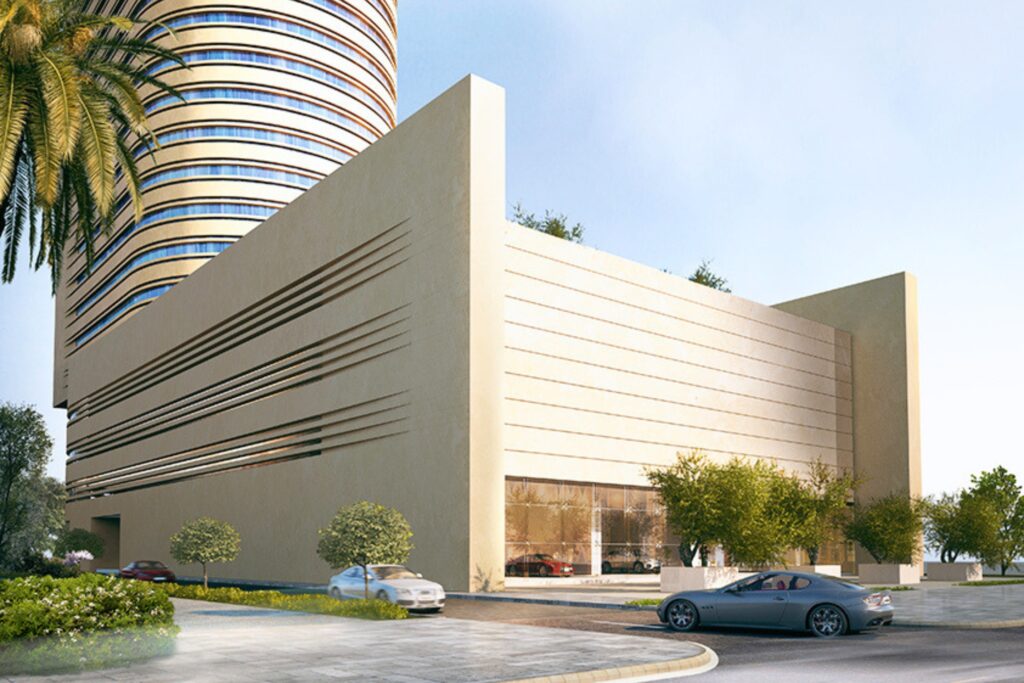
Fibre cement ventilated façade panels GCC architecture detail
Key Benefits of Ventilated Façade Systems in UAE Projects
Fire Safety Compliance (Mandatory in GCC High-Rise Projects)
Ventilated façade systems must comply with:
- UAE Fire & Life Safety Code
- Dubai Civil Defense (DCD) regulations
- EN 13501 fire classification standards
When using A2-s1,d0 non-combustible materials, systems are approved for high-rise applications.
Architectural Design Flexibility
Ventilated systems enable architects to achieve:
- Seamless monolithic façades
- Parametric façade geometries
- Modular grid systems
- Natural material expressions (stone, wood, cement, metal)
This flexibility is a key reason for widespread adoption in iconic UAE architecture.
Low Maintenance & Lifecycle Cost Efficiency
Compared to traditional cladding systems:
- Reduced repainting cycles
- Lower material fatigue
- Minimal moisture-related damage
- Lower long-term maintenance cost
Sustainability & Green Building Certification
Ventilated façades contribute to:
- LEED certification credits
- Estidama Pearl Rating compliance
- Energy performance optimization
- Reduced embodied carbon impact
Fibre Cement: The GCC’s Benchmark Façade Material
Fibre cement panels have become one of the most widely adopted façade materials across commercial, residential, and institutional developments in the UAE.
Their popularity is driven by a combination of fire safety compliance (A2 rating potential), dimensional stability, UV resistance, and design versatility.
A leading solution in this category is Obras Equatione Fibre Cement Panels, engineered specifically for ventilated façade applications in high-performance GCC environments.
Architecturally, fibre cement offers a refined, mineral-based surface expression that aligns with contemporary design language—clean, minimal, and highly adaptable across large-scale façade compositions.
From an engineering perspective, it provides predictable performance under thermal expansion, wind pressure, and humidity fluctuations, making it a reliable default specification for architects seeking balance between aesthetics and compliance.
Engineered Stone: Precision Monolithic Expression for Premium Architecture
For projects demanding a more natural stone aesthetic with enhanced technical predictability, engineered stone systems have become an increasingly important façade category.
ULMA Engineered Stone Cladding represents this evolution in façade engineering, offering the visual depth of natural stone while ensuring controlled manufacturing consistency, reduced weight, and improved installation efficiency.
In the GCC, engineered stone is particularly favored in luxury commercial developments, hospitality projects, and civic architecture where façade identity must communicate permanence, prestige, and material authenticity.
Unlike traditional stone, engineered systems allow for tighter tolerances and improved performance under thermal cycling, making them more suitable for high-rise applications where structural efficiency is critical.
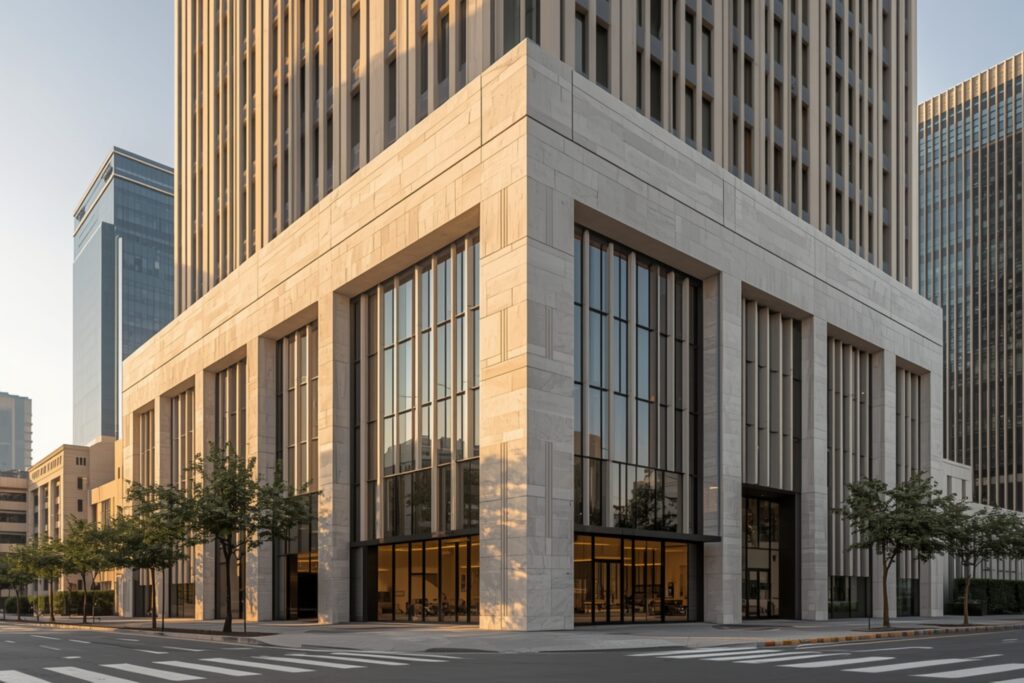
Porcelain Façade Systems: Ultra-Durable Surfaces for High-Exposure Buildings
Porcelain cladding has rapidly become one of the most advanced façade materials used in the GCC, particularly for buildings exposed to intense solar radiation and environmental stress.
Obras Porcelain Façade Cladding delivers ultra-low porosity, high scratch resistance, and exceptional UV stability, making it ideal for both horizontal and vertical façade applications.
One of the key advantages of porcelain systems is their ability to replicate a wide range of natural and architectural finishes—including stone, concrete, metal, and wood—without compromising durability or maintenance performance.
In high-rise and mixed-use developments, porcelain façades provide long-term color stability and surface integrity, making them a preferred choice for architects prioritizing lifecycle performance and design flexibility.
Terracotta Cladding: Architectural Warmth with Environmental Intelligence
Terracotta cladding systems are experiencing a strong resurgence in modern GCC architecture, particularly in hospitality, cultural, and premium residential developments.
Obras Profiled Terracotta Cladding introduces a tactile, rhythm-driven façade language that contrasts with the more minimal material palettes often used in contemporary architecture.
Beyond aesthetics, terracotta offers functional advantages in hot climates. Its natural thermal properties contribute to solar shading, reducing heat gain while allowing façades to breathe within ventilated system configurations.
This makes terracotta not only a design material but also an environmental strategy—supporting passive cooling and enhancing façade depth through shadow play and profile articulation.
Ventilated Façade vs Traditional Cladding (Performance Comparison)
| Performance Factor | Ventilated Façade | Traditional Cladding |
|---|---|---|
| Heat Reduction | High | Low |
| Moisture Protection | Excellent | Limited |
| Fire Compliance | High (A2 systems) | Variable |
| Lifespan | Long-term | Medium |
| Maintenance | Low | Higher |
Common Ventilated Façade Specification Mistakes in GCC Projects
Many façade failures in UAE projects are caused by early design-stage errors:
- Choosing materials based only on cost, not performance
- Ignoring fire classification requirements
- Incorrect cavity depth design
- Poor detailing at joints and openings
- Late substitution of approved materials
These mistakes often result in:
- Reduced façade lifespan
- Approval delays
- Cost overruns
How to Specify Ventilated Façade Systems in UAE Projects (Step-by-Step)
Step 1: Define Project Performance Requirements
- Building typology (tower, villa, commercial, mixed-use)
- Fire rating requirements
- Thermal performance targets
Step 2: Select Certified Façade Materials
Ensure:
- A2 fire-rated compliance
- Certified insulation system
- Tested façade assembly system
Step 3: Engineer the Ventilation Cavity
- Continuous airflow design
- Proper inlet/outlet ventilation
- Avoid airflow blockage at junctions
Step 4: Coordinate Early with Façade Specialists
Early-stage involvement ensures:
- Reduced construction risk
- Accurate technical detailing
- Authority approval readiness
The Future of Ventilated Façade Systems in UAE Architecture
As the UAE continues to advance its sustainability agenda and energy efficiency targets, ventilated façade systems are expected to become even more central to architectural practice. With increasing emphasis on net-zero strategies, embodied carbon reduction, and lifecycle performance, façade systems are evolving from static building components into dynamic environmental technologies.
In this context, ventilated façades are no longer viewed as an optional upgrade. They are becoming the baseline expectation for any high-performance building in the region. Their ability to integrate thermal control, fire safety, durability, and architectural expression positions them as one of the most important technologies in contemporary GCC architecture.
Ventilated façade systems represent a critical intersection between architecture, engineering, and environmental performance in the UAE and GCC. Their adoption reflects a broader shift toward performance-led design, where façades are expected to actively contribute to energy efficiency, regulatory compliance, and occupant wellbeing.
For architects and consultants, understanding ventilated façade systems is no longer optional. It is a fundamental part of delivering buildings that meet the demands of climate, regulation, and modern architectural ambition. In 2026 and beyond, they will continue to define how buildings are designed, constructed, and experienced across the region.
What is a ventilated façade system?
A ventilated façade is a multi-layer external wall system that uses an air cavity to improve thermal performance, moisture control, and durability.
Why are ventilated façades important in the UAE?
They reduce heat gain, improve energy efficiency, and protect buildings from extreme climate conditions such as heat, humidity, and sand exposure.
Are ventilated façade systems required by UAE regulations?
Yes. Most high-rise and commercial projects require compliance with UAE Fire & Life Safety Code and A2-rated material systems.