
When a villa developer or façade consultant in Dubai selects an exterior wood cladding system, they are not making an aesthetic decision alone. They are making a 30-to-50-year engineering commitment — one that will be stress-tested daily by ambient temperatures exceeding 50°C, intense UV irradiance, wind-borne sand abrasion, and coastal salt exposure in districts from Palm Jumeirah to Yas Island.
The three material categories that dominate specification discussions for natural wood cladding UAE projects — thermally modified wood (TMW), wood-plastic composite (WPC), and high-density composite panels such as those produced by Parklex Prodema — are frequently misunderstood, compared without climate context, or selected based on upfront cost rather than total life-cycle value. No authoritative GCC-specific comparison has addressed all three in the same technical framework — until now.
This article provides exactly that: a structured, technically grounded analysis of each material category against the specific demands of UAE and GCC construction. It is intended for architects, façade consultants, main contractors, and villa developers at the decision stage of specification, where material performance data matters far more than sales literature.
Understanding the Three Material Categories
Before comparing performance metrics, it is essential to understand what each material actually is — because the three categories are fundamentally different in composition, not merely in grade.
Thermally Modified Wood (TMW)
Thermally modified wood is 100% natural timber that has been subjected to a controlled high-heat treatment process, typically between 160°C and 260°C in an oxygen-reduced environment. This process fundamentally alters the wood’s cellular structure without the use of chemical preservatives. The treatment removes the free sugars and residual moisture that make natural wood susceptible to fungal decay and insect attack, resulting in a material with measurably improved dimensional stability and biological durability compared to untreated timber.
The key performance outcomes include enhanced durability, longer service life than untreated wood, and minimised swelling, shrinking, or cupping due to moisture changes. In European and Scandinavian markets — where TMW originated — it has found extensive application in external cladding, decking, and soffits. Its appeal in UAE projects lies primarily in its authentic natural timber aesthetic and its ecological credentials: no chemical treatment, FSC-certifiable source timber, and full biodegradability at end of life.
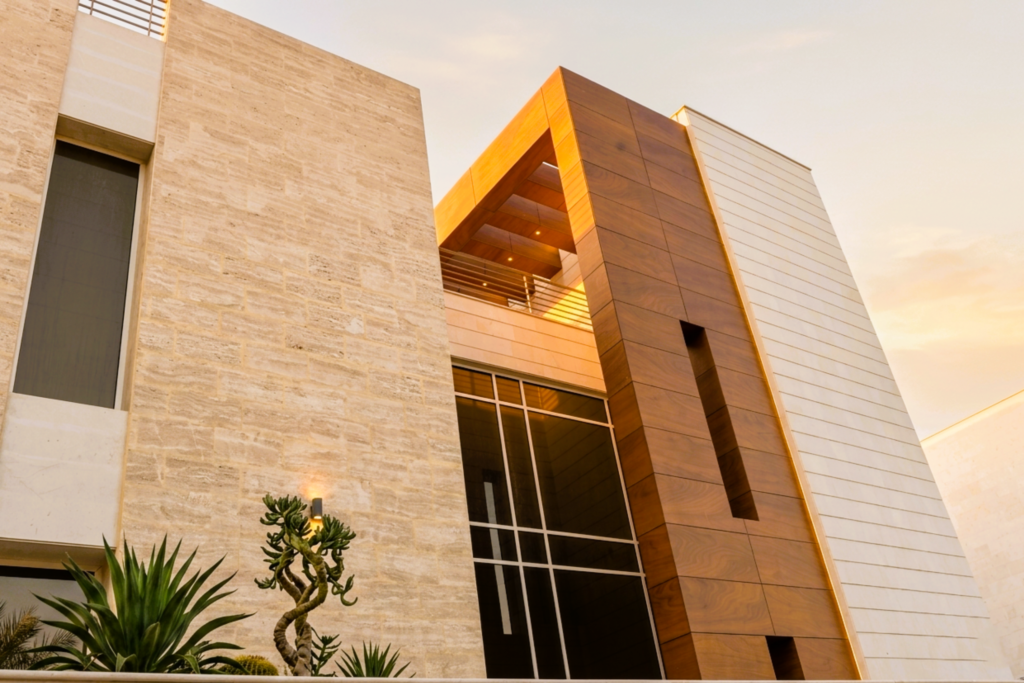
The critical limitation for GCC specification, however, is UV degradation. Unlike the moisture-driven weathering challenges TMW was engineered to address, the UAE’s primary threat to exterior timber is photochemical: intense solar radiation breaks down the lignin in wood cell walls, causing rapid silvering and surface checking. Without active intervention — typically annual application of UV-inhibiting oil — TMW façades will grey visibly within one to two seasons in Dubai.
Wood-Plastic Composite (WPC)
WPC panels are manufactured from a blend of recycled wood fibres (typically 50–70%) and thermoplastic polymers, most commonly HDPE or PVC. The composite matrix is extruded into cladding profiles that replicate timber board geometry and, increasingly, timber surface texture. The plastic components in WPC expand with heat and contract in the cold, while the wood fibres’ reaction is influenced by both temperature and moisture changes.
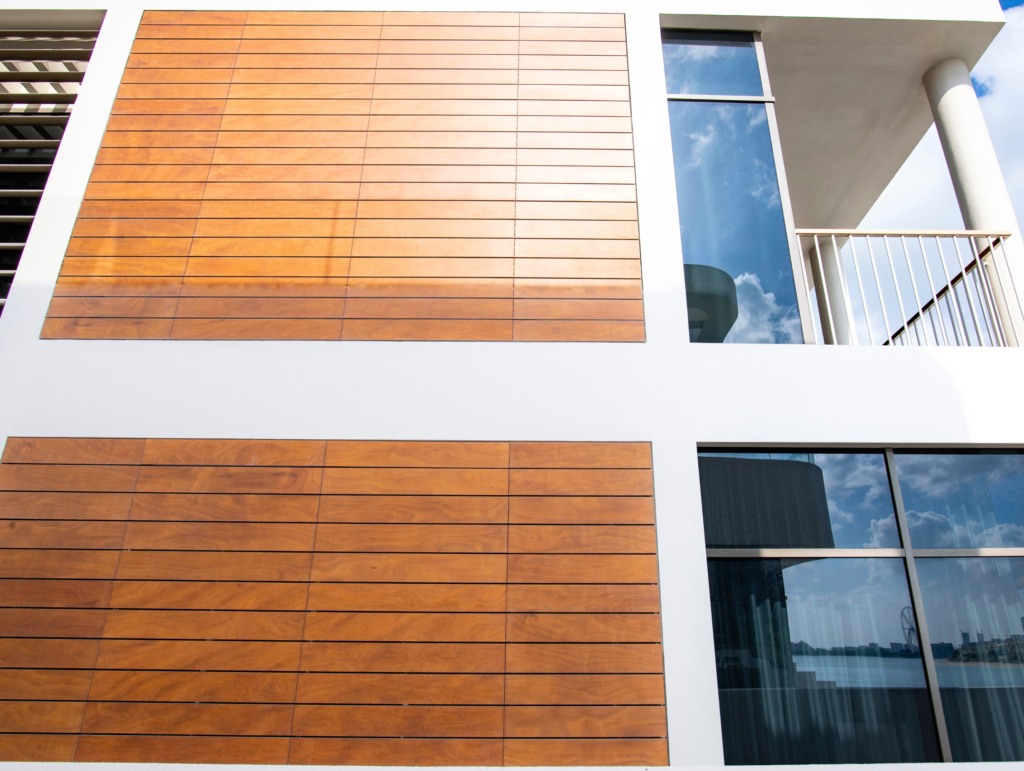
WPC’s commercial proposition for UAE villa projects rests on its low maintenance profile relative to natural wood — no oiling, no sealing, no periodic retreatment — and its resistance to biological decay. WPC decking and cladding systems are designed to resist UV radiation, moisture damage, termites, and temperature expansion while maintaining long-term structural stability.
The material’s Achilles heel in desert climates is thermal performance under extreme ambient heat. In UAE summers, the surface temperature of a south-facing cladding panel can reach 80°C or higher. Testing has shown WPC cladding thermal expansion coefficients in the range of 30.2×10⁻⁶ K⁻¹ — meaning panels undergo measurable dimensional change across the temperature range experienced in desert environments. At the lower end of the market, HDPE-heavy WPC products with insufficient fibre content can sag, creep, or deform at sustained temperatures above 60°C — a failure mode that has been documented on several UAE residential projects and is now a key evaluation criterion for façade consultants.
Co-extruded WPC — where a dense protective polymer cap layer is factory-applied over the composite core — addresses UV fading and surface degradation more effectively than first-generation hollow-core profiles. Premium co-extruded products with ASA or PVDF cap layers represent a significantly more durable specification choice, though they close the cost gap with composite panel systems.
High-Density Composite (PARKLEX PRODEMA)
High-density composite panels — exemplified in the GCC market by Parklex Prodema’s NATURCLAD range — represent a fundamentally different engineering approach. These are not wood products with surface treatment applied. They are engineered laminate systems in which kraft papers impregnated with phenolic and melamine resins are bonded under high pressure to form a high-density bakelite-like core, finished with a real natural timber veneer and sealed under a factory-applied PVDF fluoropolymer film.
The UV-resistant PVDF film protects the panels from all weather conditions, and the PVDF exterior is also anti-graffiti and non-stick, which protects the panel from organic matter and reduces the build-up of dust and dirt from air pollution — eliminating the need for maintenance or recoating that is usually required with other wood products.
The composition, featuring kraft papers impregnated with resins and an anti-graffiti PVDF coating, ensures optimal performance across various climatic conditions, façade orientations, and building heights, maintaining dimensional and chromatic stability without maintenance, even in aggressive environments such as coastal or highly polluted areas.
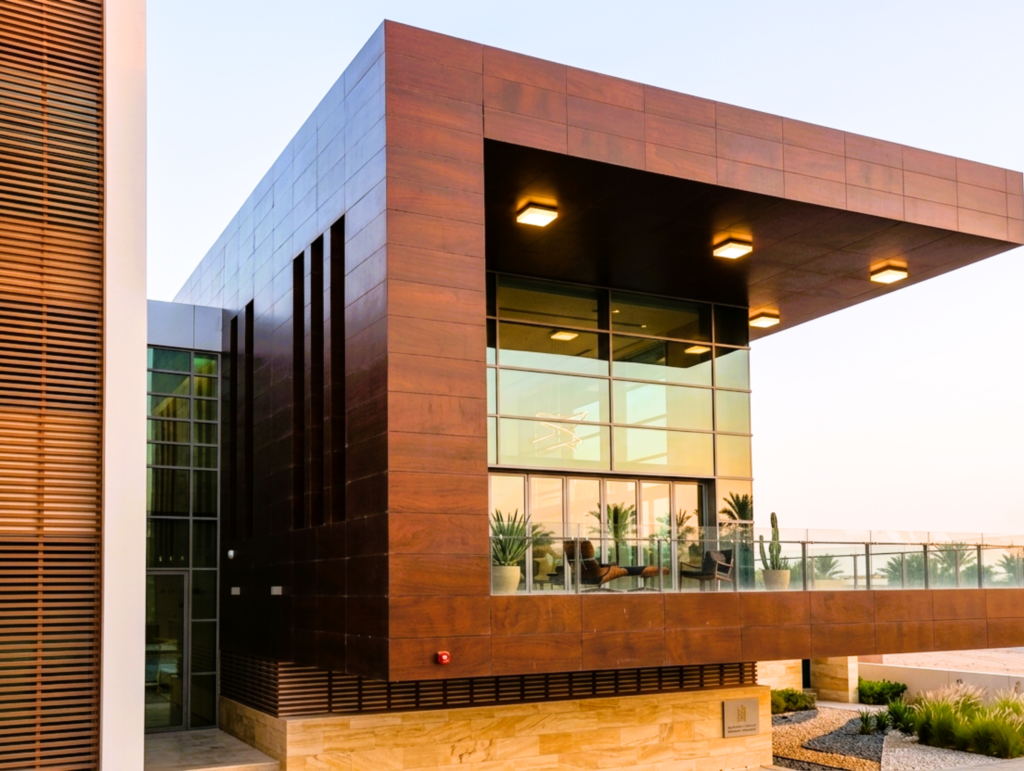
This is precisely the performance profile that UAE villa developments demand: authentic natural timber aesthetics combined with the dimensional stability, UV resistance, and fire compliance required for a high-value, low-intervention façade system.
The UAE Climate Challenge: What Cladding Materials Actually Face
To evaluate material performance objectively, the operating environment must be established clearly. The UAE presents a convergence of extreme climatic stressors that individually would challenge most exterior materials — and in combination, create one of the most demanding façade environments in the world.
Solar irradiance in Dubai reaches annual averages above 2,000 kWh/m², with peak global horizontal irradiance (GHI) values among the highest recorded anywhere. UV-A and UV-B radiation at these intensities accelerate photochemical degradation in polymers and lignin-containing materials at rates two to three times higher than Northern European benchmarks on which many material warranties are calibrated.
Ambient temperature cycling from winter lows of approximately 12°C to summer peaks above 48°C — with surface temperatures on south- and west-facing cladding panels frequently exceeding 70–80°C — creates thermal expansion and contraction cycles that stress panel fixings, joint sealants, and material interfaces annually.
Sandstorms (Shamal events) deliver abrasive particulate matter under positive pressure against façade surfaces, accelerating surface erosion on softer materials and compromising coatings that were not designed for abrasion.
Coastal salt spray, particularly relevant in Abu Dhabi, Dubai Marina, Yas Island, Palm Jumeirah, and coastal developments throughout Oman and Qatar, introduces chloride ion attack on exposed metals, sealants, and any material with surface porosity.
Thermal bridging and energy performance considerations are increasingly central to specification in the UAE, given mandatory compliance with the UAE’s Pearl Rating System (for Abu Dhabi), LEED requirements for many commercial-residential projects, and the UAE Net Zero 2050 Strategic Initiative.
Lifespan & Durability: Full Technical Comparison
The table below draws on manufacturer technical data, regional installation case studies, and published material science literature to present a structured comparison against UAE-specific performance criteria.
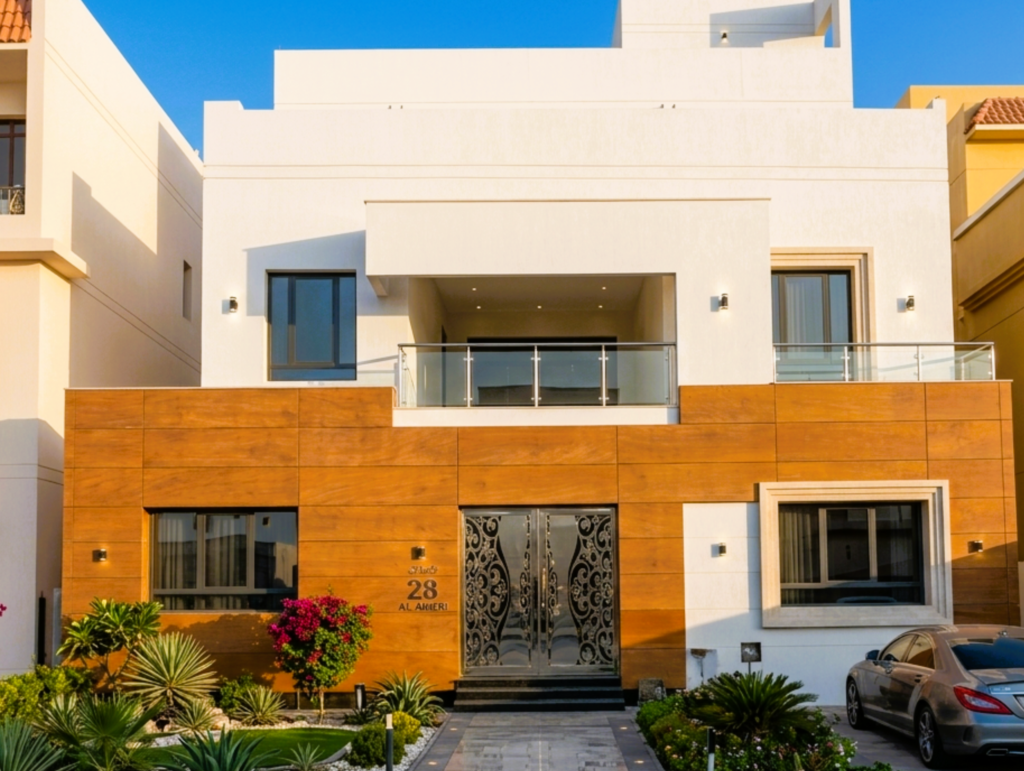
Comparative Performance Matrix — UAE Exterior Cladding
| Performance Criterion | Thermally Modified Wood (TMW) | Wood-Plastic Composite (WPC) | High-Density Composite (Parklex Prodema NATURCLAD) |
|---|---|---|---|
| Expected Lifespan in UAE | 25–30 years (with maintenance) | 20–30 years | 50+ years |
| Core Composition | 100% natural timber, heat-treated | Recycled wood fibres + HDPE/PVC polymer | Kraft paper + phenolic resin core + natural timber veneer + PVDF outer film |
| UV Resistance | Poor without treatment; greys within 1–2 seasons | Moderate; cap-coated products perform better | Excellent; PVDF film certified to EN 438-6 at 5× standard exposure values |
| Thermal Expansion Coefficient | Low–Moderate (~4–8 × 10⁻⁶ /°C along grain) | Moderate–High (~30 × 10⁻⁶ /°C) | Very Low; dimensionally stable across UAE temperature range |
| Maintenance Required | High — annual UV-inhibiting oil treatment essential | Low — periodic power washing; no oiling | Zero — no sanding, oiling, sealing, or recoating throughout service life |
| Fire Classification | Typically D–E (EN 13501-1) for untreated | Variable; C–D typically without additives | B-s1,d0 (NATURCLAD-W) and A2-s1,d0 (GRCLAD-B) per EN 13501-1 |
| Sandstorm/Abrasion Resistance | Moderate; surface oils require reapplication after abrasion events | Moderate; hollow profiles susceptible to surface scoring | High; PVDF coat provides hardness and anti-adhesion resistance |
| Coastal/Salt Performance | Poor; untreated grain absorbs chlorides | Good; polymer content resists salt | Excellent; PVDF and resin core are chemically inert to chloride environments |
| Sustainability Credentials | FSC/PEFC certifiable; fully biodegradable | Recycled content (HDPE + wood fibre); not biodegradable | PEFC/FSC certified timber veneer; EPD available; ISO 14006 ECOdesign; LEED/BREEAM eligible |
| LEED/Green Rating Contribution | Partial (FSC timber credit) | Partial (recycled content credit) | Yes — contributes to multiple LEED/BREEAM credits; EPD available |
| Approx. Installed Cost (UAE) | AED 350–550/m² | AED 250–450/m² | AED 700–1,100/m² |
| Primary Vulnerability in UAE | Rapid UV degradation; brittleness increases post-modification | Thermal creep/sag in sustained 60°C+ surface temps (lower-grade products) | Higher upfront capital cost |
Fire Compliance: A Non-Negotiable for UAE High-Rise and Villa Projects
UAE fire safety requirements for external cladding have been substantially reinforced since the 2012 and 2015 high-rise fire events that prompted the UAE Civil Defence and Trakhees to mandate non-combustible or limited-combustibility cladding systems on buildings above a specified height threshold. For architects and façade consultants specifying wood cladding on UAE villas and low-rise residential buildings, fire classification remains a key due diligence requirement — particularly for multi-unit villa clusters, hospitality developments, and government-procured residential projects.
PAEKLEX PRODEMA’s fire-resistant GRCLAD-W panels achieve B-s1,d0 classification, and GRCLAD-B panels achieve A2-s1,d0 classification, allowing their use in high-rise buildings under the most stringent regulations.
GRCLAD panels are BR 135 compliant and five finishes classify as A2-s1-d0 according to EN 13501, with the panels capable of withstanding extreme UV weather conditions. For UAE projects requiring compliance with BS 8414 test methodology — increasingly referenced by UAE Civil Defence for external cladding systems — this certification pathway is a significant specification advantage.
For standard WPC and TMW products, achieving equivalent fire classification typically requires additional intumescent treatment or the specification of proprietary fire-rated sub-variants, adding cost and supply chain complexity. Architects specifying wood-aesthetic cladding on projects with fire compliance requirements should confirm the exact classification certification and relevant test standards before finalising material schedules.
10-Year Maintenance Cost Analysis: What the UAE Climate Really Costs You
One of the most consequential and least-discussed variables in the TMW vs WPC vs composite cladding debate is not the material cost but the total cost of ownership across a 10-year maintenance cycle. In the UAE market, labour costs, the logistics of working on completed villa façades, and the operational disruption of scaffolding-dependent maintenance programmes materially affect the economics of lower-capital, higher-maintenance cladding specifications.
Thermally Modified Wood — 10-Year Maintenance Scenario: An architect specifying TMW cladding on a 500m² villa façade in Dubai should factor in, realistically, annual UV-inhibiting oil treatment. With UAE specialist labour rates and material costs, this equates to approximately AED 35–55 per m² per maintenance cycle, or AED 175,000–275,000 in cumulative maintenance spend over 10 years on a typical large villa. Without this maintenance, surface silvering and micro-cracking will begin within 12–18 months and will require more intensive remediation — sanding, priming, and full refinishing — adding further cost.
WPC — 10-Year Maintenance Scenario: Premium co-extruded WPC with cap layers requires only periodic cleaning — power washing to remove accumulated sand and dust, which in the UAE should be scheduled every six months given the frequency of Shamal events. Maintenance costs over 10 years are low: approximately AED 10–15 per m² per cycle, totalling AED 25,000–40,000 for the same 500m² façade. However, lower-specification WPC products that exhibit thermal deformation or UV colour shift may require panel replacement within years 8–12, resetting the cost baseline significantly.
High-Density Composite (Parklex Prodema) — 10-Year Maintenance Scenario: Parklex Prodema panels maintain their appearance and high-quality standards without any further maintenance, eliminating the need for additional care. Maintenance for the 10-year period is limited to occasional cleaning — a dry or damp cloth is typically sufficient for the anti-graffiti, non-stick PVDF surface, with no specialist contractor or scaffolding required. Total 10-year maintenance cost: effectively zero beyond routine cleaning. The manufacturer offers a 10-year warranty on all products.
The Total Cost of Ownership Calculation: When the combined capital and maintenance costs are modelled over 10 years, the higher upfront investment in high-density composite panels closes substantially against both alternatives. For a large UAE villa project, the capital premium of AED 150–400 per m² over WPC is frequently recovered within years 6–8 of the maintenance cycle, before factoring in the extended 50+ year design life and the avoidance of partial replacement costs.
Ventilated Façade Integration: A Technical Imperative
All three cladding materials perform best — and in the UAE achieve compliance with thermal performance requirements — when installed as part of a ventilated façade system. A ventilated façade incorporates a structured air cavity between the exterior cladding panel and the building’s thermal insulation layer, allowing convective airflow to dissipate heat accumulated in the outer cladding, reduce thermal bridging, and manage moisture vapour movement through the wall assembly.
In UAE conditions, a ventilated façade system reduces the surface temperature of the cladding panel by managing heat accumulation — a direct benefit to WPC products that are temperature-sensitive, and a significant contribution to building energy performance by reducing cooling loads. For TMW products, the ventilation cavity also reduces the cyclic moisture fluctuation that drives surface checking.
Parklex Prodema’s NATURCLAD system is specifically engineered for ventilated façade application, with certified technical guides for ventilated façade sub-systems, fixing methodologies, and joint configurations that comply with international façade standards.
For architects and façade engineers specifying in the UAE, the ventilated façade sub-system selection — aluminium T-profiles, bracket type, insulation specification — should be resolved in conjunction with the cladding material selection, not after it. OBRAS International, as a GCC specialist in ventilated façade systems, provides integrated material and sub-system specification support for this reason.
Sustainability and Green Building Compliance in the UAE
The UAE’s commitment to sustainability — formalised through the UAE Net Zero by 2050 Strategic Initiative, Abu Dhabi’s Pearl Rating System, and the widespread adoption of LEED and BREEAM on commercial and residential projects — has elevated the specification importance of material Environmental Product Declarations (EPDs), chain-of-custody certifications, and recycled content documentation.
Parklex Prodema timber veneers are sourced from sustainably managed PEFC-certified forests, guaranteeing that wood boards have been made with raw materials from forests managed in a socially and environmentally responsible way.
The NATURCLAD-W system is certified to ISO 14006 for ECOdesign, and contributes positively to LEED or BREEAM certifications. The availability of a published EPD is a specific requirement of some UAE government projects and increasingly requested by international developers operating in the GCC.
TMW retains a strong sustainability profile in terms of natural material content and end-of-life biodegradability, though its FSC/PEFC certification depends on the specific species and supply chain. WPC’s sustainability case rests on recycled content, but the plastic polymer component is not biodegradable and EPD documentation for WPC products is less consistently available than for high-density composite systems.
For projects pursuing LEED certification in the UAE — a growing requirement for hospitality, mixed-use, and premium residential developments — the EPD, ECOdesign certification, and green rating contribution of the specified cladding material should be formally verified with the supplier before material schedule finalisation.
GCC Market Outlook: Natural Timber Aesthetics at Engineering Performance Levels
The Middle East and Africa region, while smaller in absolute thermally modified wood market share, is expanding steadily due to rising investments in luxury real estate and infrastructure, particularly in the UAE and South Africa. This trajectory reflects a broader market trend across the GCC: premium residential developments — villas in Dubai Hills, Jumeirah Golf Estates, Saadiyat Island, and new masterplans in Saudi Arabia’s Diriyah Gate and NEOM — are specifying natural wood aesthetics at the façade level, but procurement teams and project managers are increasingly aware of the operational implications of choosing natural timber without engineering-level performance enhancement.
The specification shift underway across GCC villa projects is toward engineered wood cladding systems that deliver authentic timber character without the maintenance burden of natural or minimally treated wood. High-density composite panels are the primary beneficiary of this shift, driven by their demonstrated 50+ year performance life, zero-maintenance profile, and fire compliance credentials. WPC maintains a strong position in mid-range residential and hospitality projects where upfront budget constraints are significant and co-extruded cap technologies continue to improve. TMW is finding its most defensible position in low-rise shaded applications — soffits, internal courtyard cladding, and areas where UV exposure is reduced and maintenance access is straightforward.
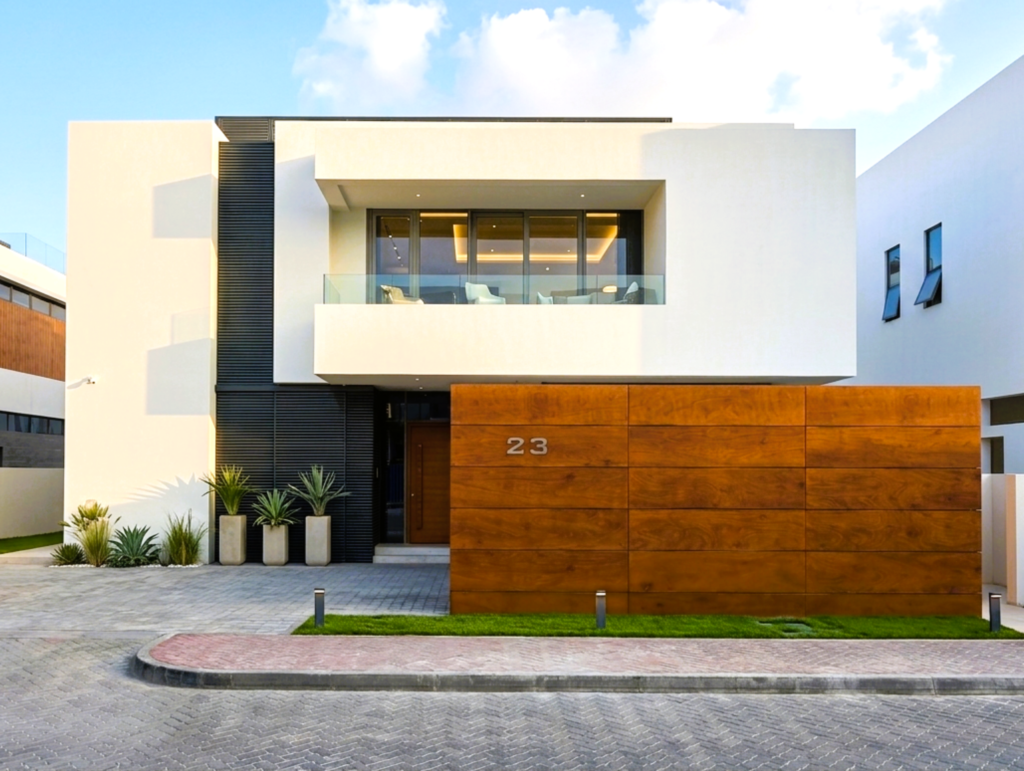
Which Material Should You Specify?
The correct answer is project-specific and depends on budget profile, building height, fire compliance requirements, green rating target, and access to ongoing maintenance. However, based on the technical analysis above, the following generalised guidance applies to UAE and GCC villa and residential façade projects:
Specify High-Density Composite (Parklex Prodema NATURCLAD) when: the project demands long-term authentic timber aesthetics with zero maintenance, fire classification compliance, LEED/BREEAM contribution, coastal or high-UV exposure, or a design life exceeding 30 years. This is the highest-performing specification for premium UAE villa and hospitality façades where total cost of ownership is the relevant evaluation metric.
Specify WPC (co-extruded, premium grade) when: budget constraints are significant, the design brief accepts a composite timber aesthetic rather than authentic timber, the application is partially shaded or in a lower UV-intensity orientation, and the project team can verify thermal performance under UAE-specific surface temperature conditions.
Specify Thermally Modified Wood when: the brief specifically requires authentic natural timber with visible grain and natural variation, the application includes shaded or partially covered elements that reduce UV loading, and a proactive maintenance protocol with annual reapplication is resourced and contractually committed from the outset.
What is the best exterior wood cladding for UAE villas in terms of longevity?
For UAE villa façades where design life, UV resistance, fire compliance, and minimal maintenance are the primary criteria, high-density composite panels — such as Parklex Prodema NATURCLAD — represent the highest-performance specification. Their PVDF-protected timber veneer surface delivers authentic wood aesthetics with no oiling, sealing, or periodic retreatment, and their EN 13501-1 fire classification makes them compliant with UAE Civil Defence requirements for multi-storey and premium residential applications. Tested to five times the EN 438-6 standard for artificial weathering resistance, these panels are specifically suited to the intense UV irradiance and thermal cycling experienced in Dubai and Abu Dhabi.
Does thermally modified wood last in the Dubai climate without regular maintenance?
No — and this is one of the most important specification realities for UAE architects and developers to understand. While thermal modification significantly improves wood’s resistance to biological decay and dimensional moisture movement, it does not protect against photochemical UV degradation. Under Dubai’s solar irradiance levels, an untreated thermally modified wood façade will begin to silver and develop surface micro-cracking within 12–18 months. Annual application of a UV-inhibiting penetrating oil is the minimum maintenance requirement to preserve appearance and prevent accelerated surface deterioration. Without this programme, the material’s warranty and performance life are significantly compromised.
Is WPC cladding safe to use in high-temperature UAE conditions?
It depends heavily on product grade and specific formulation. Entry-level WPC products with high HDPE content and hollow-core profiles can exhibit thermal creep, sagging, and colour shift at sustained surface temperatures above 60°C — conditions regularly exceeded on south- and west-facing UAE façades in summer. Premium co-extruded WPC with ASA or PVDF cap layers and solid or reinforced profiles are significantly more thermally stable, with published thermal expansion coefficients that can be evaluated against UAE temperature ranges. Specifiers should always request temperature-specific technical data sheets and UAE project references before specifying WPC for exposed façade applications.
What fire rating do I need for wood cladding on a villa in the UAE?
Fire classification requirements for UAE exterior cladding depend on building height, occupancy type, and the specific emirate’s Civil Defence guidelines. For low-rise villas (typically G+2 or below), the minimum requirement is generally Class C or B per EN 13501-1 or equivalent under UAE Fire and Life Safety Code of Practice. For buildings above 15m, non-combustible or limited-combustibility materials (Class A2 or B) are typically required. Parklex Prodema’s NATURCLAD-W achieves B-s1,d0 and the GRCLAD-B range achieves A2-s1,d0 under EN 13501-1 — the most relevant classifications for UAE compliance. Always confirm the specific Civil Defence approval and building permit requirements with the relevant authority before finalising specification.
How do maintenance costs for wood cladding compare over 10 years in the UAE?
The 10-year total cost of ownership varies substantially by material category. Thermally modified wood on a typical 500m² villa façade will incur cumulative maintenance costs of approximately AED 175,000–275,000 through annual UV oil treatment programmes. Premium co-extruded WPC requires only periodic cleaning, bringing 10-year maintenance spend down to approximately AED 25,000–40,000 for the same façade area. High-density composite panels such as Parklex Prodema NATURCLAD require no specialist maintenance treatment — cleaning only — making 10-year maintenance costs negligible. When these figures are added to material and installation costs, the apparent capital premium of high-density composite systems over WPC often diminishes or reverses across a 10–15-year evaluation horizon.