
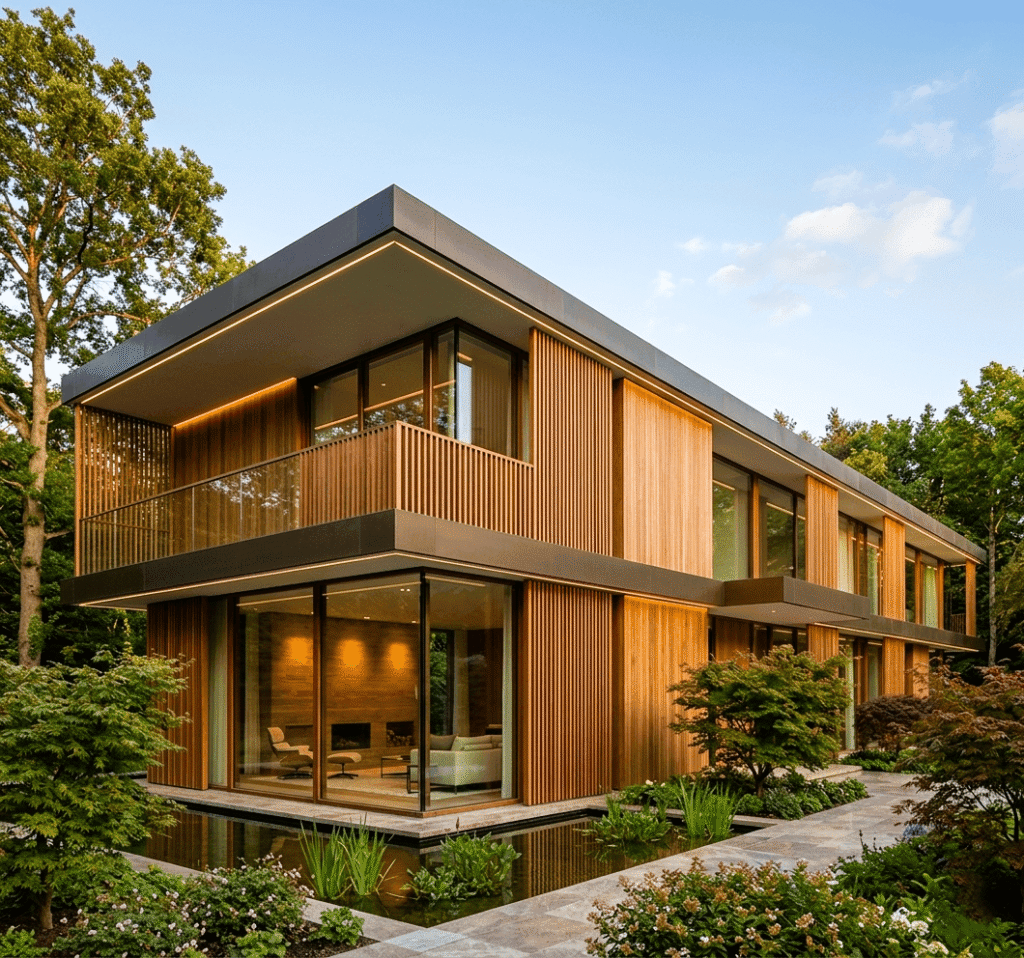
“Façade cladding is no longer a late-stage aesthetic decision. Across the UAE and GCC, it has become one of the most technically complex, regulatory-sensitive, and commercially consequential choices a developer or project management consultant makes — and under-specified decisions carry serious downstream consequences: Civil Defence rejection, project delays, sustainability rating failures, and long-term maintenance liability.”
The UAE façade market is valued at USD 4.10 billion in 2025 and is forecast to reach USD 5.6 billion by 2030, driven by Dubai’s building-permit surge, Abu Dhabi’s Vision 2040 pipeline, and mandatory compliance under Estidama and the UAE Fire and Life Safety Code of Practice. Whether you are a developer assembling a design brief, a PMC managing a façade tender, or an engineering consultant reviewing a specification package, what follows is a structured, code-referenced methodology for specifying cladding across the UAE and GCC.
Define the performance brief before selecting any material
The most common and costly mistake in GCC cladding specification is selecting a material before establishing a performance brief. A specification brief must answer four non-negotiable questions before any shortlisting begins.
1.1 Building classification
The UAE Fire and Life Safety Code of Practice classifies buildings by occupancy type and height. Classification determines the minimum fire performance class of the cladding system, the extent of cavity fire barriers required at each floor level, and whether a full-scale fire test report or Engineering Judgement (EJ) from an accredited body is required. Obtain your building’s occupancy classification before approaching any materials supplier — this single data point eliminates a significant share of non-compliant products from consideration.
1.2 Climatic loads
The GCC presents one of the world’s most demanding environmental envelopes: sustained ambient temperatures exceeding 45°C, intense solar radiation, high humidity in coastal zones, sand-laden Shamal wind events, and elevated saline corrosion exposure near the Arabian Gulf. Wind load analysis should be conducted in accordance with ASCE 7 or EN 1991-1-4. Thermal movement coefficients, UV degradation resistance, and corrosion classification (ISO 9223, typically C3 or C4 for coastal projects) must be specified for all substructure components.
1.3 Sustainability rating requirements
Abu Dhabi mandates the Estidama Pearl Rating System for all new buildings. Dubai operates the Al Sa’fat Green Building Rating System. Saudi Arabia applies Mostadam. Each rating system has direct implications for material selection — specify sustainability requirements in the brief before issuing any façade tender.
1.4 Maintenance and lifecycle strategy
A system requiring scaffold access for routine cleaning on a 45-storey tower carries a fundamentally different total cost profile than a rainscreen panel washable from ground level. Sand accumulation, UV-induced colour shift, panel replacement logistics, and substructure inspection access are all specification-stage concerns, not afterthoughts.
Establish fire rating compliance — the non-negotiable gateway
In the UAE, fire performance compliance gates Civil Defence approval, which in turn gates an occupancy permit. No other specification criterion supersedes it.
All cladding suppliers in the UAE must hold active Civil Defence registration. Any deviation from a tested and certified system configuration requires a formal Engineering Judgement from an accredited certification body, supported by undertakings from all project stakeholders.
2.1 UAE Fire and Life Safety Code requirements
The Code sets out small-scale and full-scale fire testing requirements for exterior cladding systems, permitting testing to NFPA, ASTM, BS 8414, and EN 13501-1 standards. Cavity fire barriers must be installed at every floor level within the void between the cladding and primary substrate, and around all façade openings. Saudi Arabia’s SBC 801 and Qatar’s Civil Defence requirements operate on analogous principles with local variation — a BS 8414 certificate does not substitute for local Civil Defence approval in any GCC jurisdiction.
2.2 Fire performance by material category
EQUITONE
Certified A2-s1,d0 under EN 13501-1 — the highest achievable non-combustibility rating for non-load-bearing façade materials. Simplifies Civil Defence compliance for high-rise applications.
PARKLEX PRODEMA
Fire-treated variants available for specific building categories. Requires case-specific engineering review for high-rise or high-occupancy applications. Consult us for applicable system certification.
Project-specific review required
WOODN
WPC louvre, façade & ceiling profiles
Hollow-profile wood-plastic composite system engineered for louvre screens, vertical façade panels, pergolas, and soffit cladding. Fire performance is formulation and system-dependent.
Confirm per system & occupancy
EXTERPARK
Fire-treated variants available for specific building categories. Requires case-specific engineering review for high-rise or high-occupancy applications. Consult us for applicable system certification.
Confirm per system & occupancy
exaTECH
Non-combustible inorganic substrate. Zero water absorption, complete resistance to biological growth. Suitable for the full range of building classifications subject to system-level certification.
ARGOS
Large-format ceramic & porcelain
Non-combustible and non-porous. Suitable for both ventilated façade and wet-set floor installations. Strong preference for high-rise applications requiring zero combustibility.
Key principle
System-level certification
Fire tests must cover the complete assembly — panel, substructure, insulation, fixings, and cavity barriers — not the panel in isolation. Deviations from the tested configuration require Engineering Judgement.
Wind load analysis and substructure engineering
A cladding panel is only as structurally reliable as the substructure to which it is anchored. In the GCC, wind-driven sand and episodic Shamal events impose lateral loads that must be rigorously calculated — particularly on high-rise towers where wind pressure profiles change dramatically with building height.
Ventilated façade substructures for GCC projects are typically designed in aluminium alloy (EN AW-6063 or 6005A), galvanised steel, or stainless steel. For coastal projects in Dubai Marina, Abu Dhabi Corniche, Jeddah waterfront, or Doha’s West Bay district, stainless-steel brackets and fixings are the industry standard to resist chloride-induced corrosion over a 25–50-year service life.
Exterior surface temperatures on unshaded south-facing façades in Dubai can reach 75–85°C in summer. Panel-to-panel joint widths and bracket sliding connections must be calculated for a temperature differential of 60°C or greater. Sealant and backer rod specifications must be rated for the full temperature cycling range.
Select the façade system type
4.1 Ventilated rainscreen façade — the GCC preferred system
The ventilated façade — in which a continuous air cavity separates the exterior cladding from the building’s thermal insulation — is the preferred system typology across high-performance GCC projects. The cavity serves four critical functions: thermal decoupling (reducing heat transfer to the interior), moisture management (allowing drainage and evaporation), pressure equalisation (minimising water ingress through joints), and acoustic attenuation. In a climate where HVAC can account for 60–70% of a building’s total energy consumption, this thermal benefit is not a performance bonus — it is a code compliance tool.
The global ventilated rainscreen façade market, valued at USD 37.8 billion in 2024, is growing at 5% CAGR through 2034, with the GCC among the fastest-growing regional markets. PARKLEX PRODEMA, EQUITONE, exaTECH, and ARGOS panels are all engineered for ventilated façade assembly.
4.2 Rainscreen without a full ventilated cavity
In certain low-rise or fully screened applications, a partial rainscreen approach — panels fixed to a drained and ventilated subframe without a full through-ventilated cavity — may be appropriate. This is less common in the GCC for primary high-rise façade applications but frequently used for podium levels, retail frontages, and internal atrium linings.
4.3 Direct-fix and semi-ventilated systems
Some interior and semi-exterior applications — hospitality lobbies, covered external areas, pergola structures — utilise direct-fix panel systems where full cavity ventilation is not feasible. PARKLEX PRODEMA, WOODN ceiling profiles, and large-format ARGOS ceramic tiles are each available in configurations suited to these applications. Fire performance assessment for direct-fix assemblies differs from ventilated systems and must be confirmed separately.
Specify the cladding material — GCC performance profiles
PARKLEX PRODEMA — Natural wood veneer cladding
PARKLEX PRODEMA panels are manufactured with a natural wood veneer surface laminated onto a high-pressure composite core, engineered for outdoor façade exposure. The phenolic resin binding system provides UV resistance, dimensional stability, and moisture resistance not achievable with untreated timber — critical in a climate that subjects exterior surfaces to intense ultraviolet radiation throughout the year. Available in a range of natural wood species, allowing architects to achieve the warmth and biophilic quality of timber on building envelopes where solid hardwood would be impractical. Suitable for interior and exterior applications: lobby linings, shopfront elements, covered external areas, and ventilated façades where building classification permits.
EQUITONE — Fibre cement cladding
Manufactured in Belgium to EN 12467 Class 5 (the highest category for durability and dimensional stability), EQUITONE panels are through-coloured or surface-finished with a range of textures — from raw exposed-aggregate surfaces to smooth architectural finishes. Dimensionally stable across GCC temperature ranges, maintaining flatness and joint alignment without the thermal distortion risk of aluminium composite materials. Available in large formats that reduce panel count, joint frequency, and installation time. Suitable for rainscreen, direct-fix, and cassette fixing systems. The A2-s1,d0 fire classification simplifies Civil Defence compliance for high-rise and high-occupancy buildings.
exaTECH — High-tech ceramic cladding
Ultra-thin, high-strength porcelain panels engineered for exterior façade applications in the most demanding climatic and programmatic conditions. Zero water absorption and complete resistance to biological growth — a particular advantage in humid coastal environments. Extreme hardness and surface resistance to abrasion, chemical exposure, and graffiti. Large-format panels with minimal visible joints enable a monolithic architectural expression increasingly favoured in Dubai and Abu Dhabi trophy development. Available in surface finishes that credibly simulate stone, concrete, and metallic aesthetics without the weight, cost, or quarrying constraints of natural stone.
WOODN & EXTERPARK — WPC louvre, façade & decking
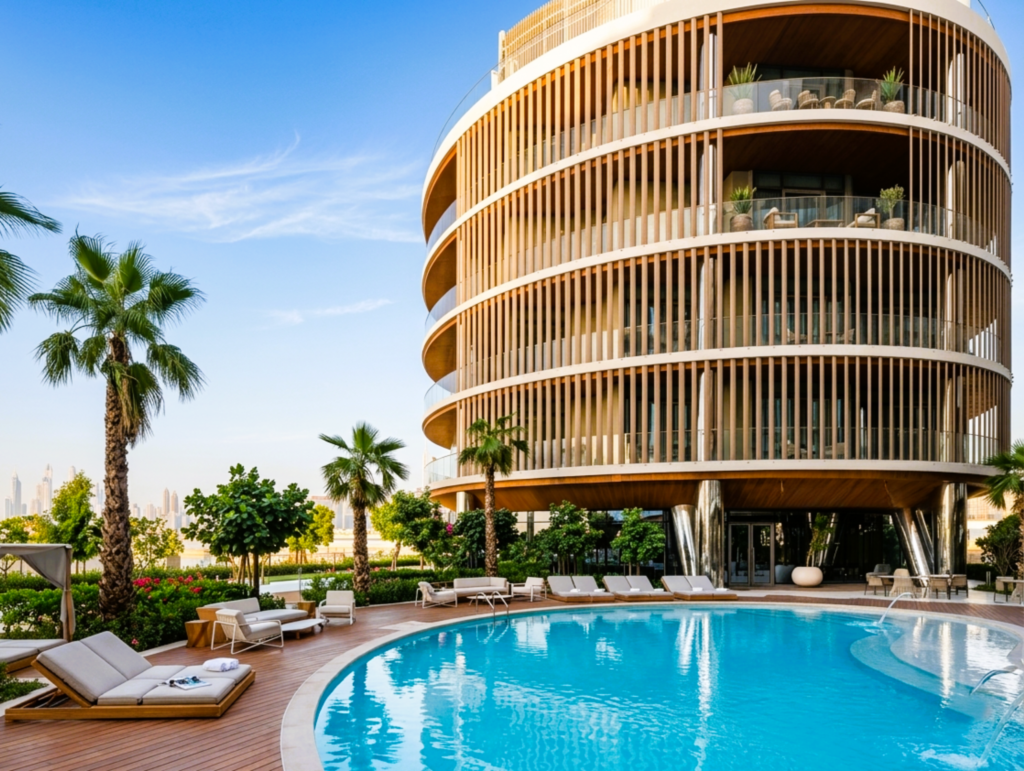
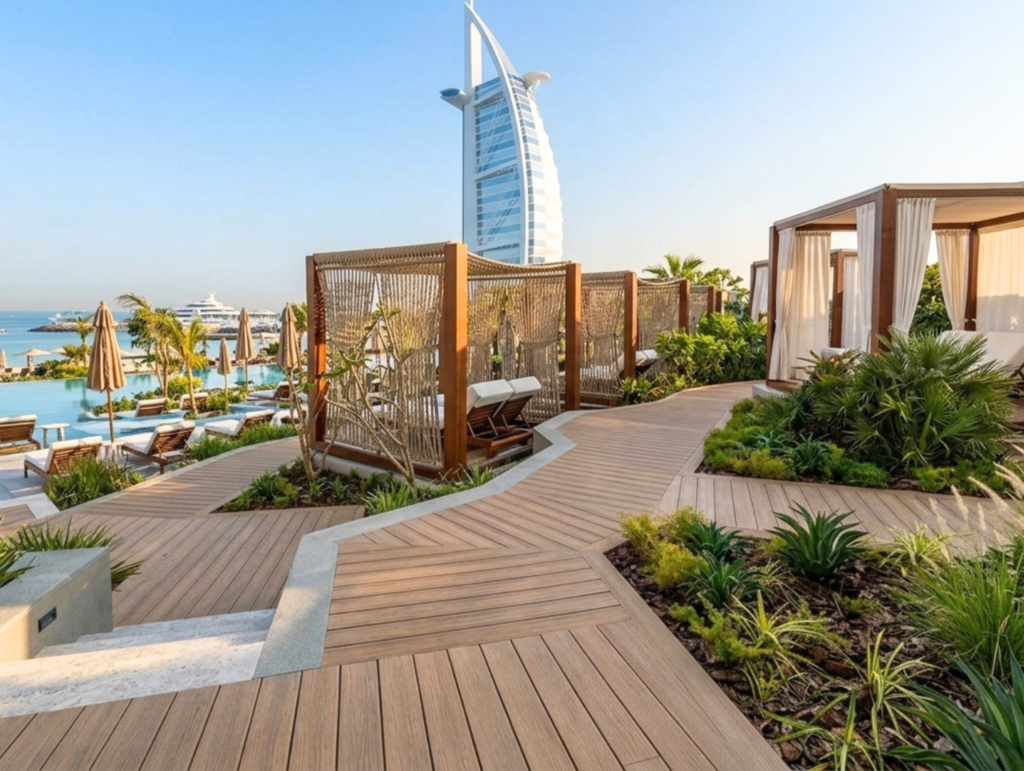
WOODN specialises in hollow-profile WPC systems for louvre screens, vertical façade panels, ceiling and soffit cladding, and pergola structures — applications where shade, privacy, and visual warmth are architecturally valuable. EXTERPARK focuses on WPC cladding and decking for amenity terraces, pool decks, landscaped podiums, and hospitality outdoor areas. Both offer no painting, staining, or sealing requirements (a direct operational cost saving versus solid timber), resistance to insect damage, and consistent colour and texture batch-to-batch — enabling future replacement panels without visual discontinuity.
ARGOS — Large-format ceramic cladding & floors
Available in formats exceeding 3,000 × 1,500mm, ARGOS panels are specified for both exterior façade and interior floor applications across commercial, hospitality, and high-end residential projects. Large formats with continuous veining and pattern registration create seamless visual continuity — an aesthetic quality increasingly central to luxury hospitality and premium residential specifications across the GCC. Suitable for both ventilated façade and wet-set floor installation, enabling material continuity from exterior cladding through to interior floor finishes.
Evaluate fixing methods and installation systems
Principal fixing categories in the GCC ventilated façade market
- Visible mechanical fixing — Panels fastened with exposed screws, rivets, or clips. Lower installed cost; panels straightforward to replace individually. Aesthetic limitation: fixing heads visible on the panel face.
- Concealed mechanical fixing — Panels retained by hidden clips or cassette folds that engage a continuous rail. No visible fixings on the panel surface. Preferred specification for premium architectural applications. EQUITONE concealed cassette and PARKLEX hidden-fix systems operate on this principle.
- Kerf and groove fixing — Panel edges precision-cut with a kerf into which a stainless-steel clip engages. Allows panels to be removed and replaced without disturbing adjacent panels — a significant maintenance advantage in high-rise applications. Common in large-format ceramic and stone specifications.
- Bonded fixing — Panels structurally bonded with high-performance adhesive. Used in direct-fix and internal applications. Not recommended for exterior ventilated façade primary panels in the GCC due to thermal cycling stresses applied to adhesive bonds.
All fixing systems must be specified with tested wind uplift resistance and shear capacity certification. In the UAE, this documentation forms part of the Civil Defence and municipality submission package. Verify that the fixing system’s tested capacity envelope covers the wind load parameters calculated for your specific project.
Assess thermal and energy performance
The UAE National Energy Strategy 2050 and Abu Dhabi’s Estidama Pearl Rating System both mandate measurable reductions in building energy consumption. The exterior cladding system is a primary determinant of a building’s thermal envelope performance.
In a ventilated façade assembly, the insulation layer is typically continuous mineral wool or rigid insulation board fixed to the primary structural wall, behind the ventilated cavity. The continuity of this insulation layer — and the minimisation of thermal bridges through brackets and fixings that penetrate it — is critical to achieving target U-values. Specify bracket systems with thermal break elements. In high-performance projects targeting 2-Pearl Estidama or LEED Gold equivalent, thermal bridging calculations under ISO 10211 should be part of the façade engineer’s scope.
Panel colour and surface finish significantly influence solar heat gain. Some ceramic and composite panel finishes are available with independently tested Solar Reflectance Index (SRI) values — an increasingly specified metric for façades in extreme solar climates.
Develop the maintenance and lifecycle plan
Maintenance requirements by material
PARKLEX PRODEMA: Periodic pressure washing. No chemical stripping or refinishing required for phenolic-laminate panels. Annual inspection recommended for sealing at penetration points.
EQUITONE: Low maintenance. Uncoated surfaces pressure washed. Coated surfaces require mild detergent washing. No repainting required for through-coloured products.
exaTECH & ARGOS: Minimum maintenance. Non-porous surface resists dust adhesion. Periodic pressure washing or automated building maintenance unit (BMU) wash cycle.
WOODN & EXTERPARK: Annual brushing to remove organic debris from hollow-profile surfaces. No sealing or refinishing. Inspect fixings and substructure annually.
Prepare the specification package and tender documents
GCC cladding specification package — required components
Performance specification: minimum fire rating, wind load resistance, thermal performance, and sustainability credits – non-negotiable
System description: ventilated façade / direct-fix / hybrid; substructure material and finish; fixing methodology – non-negotiable
Material schedule: panel product, format, finish, colour reference, surface texture, and applicable test certifications – non-negotiable
Supplier and installer qualifications: Civil Defence registration number, ISO certifications, regional project references – Compliance
Technical submittals: fire test reports, wind uplift test reports, thermal performance calculations, MSDS, product warranties – Compliance
Project-specific maintenance manual to be delivered by supplier as part of contract deliverables – Best practice
Engage a specification consultant early
The complexity of GCC cladding specification — spanning regulatory compliance, engineering performance, material science, and programme management — makes early specialist engagement one of the highest-value decisions a developer can make. A specification consultant engaged at RIBA Stage 2 or equivalent can eliminate non-compliant products before they are designed into the project, optimise material selection for the performance brief, prepare a specification package that attracts competitive and qualified bids, support the Civil Defence submission, and act as a single technical point of accountability across multiple material suppliers.
GCC market outlook: what developers are specifying in 2025–2030
The UAE façade market’s 6.5% CAGR trajectory reflects several structural shifts in specification behaviour that developers and PMCs should understand when planning procurement.
Ventilated façade adoption accelerating
Mandatory Estidama and Al Sa’fat compliance, combined with reductions in energy subsidies, is driving developers toward high-performance ventilated cavity systems that demonstrably reduce cooling loads.
Non-combustible materials becoming the default
Post-UAE tower fire awareness has made A2-classified materials the specification baseline on any project targeting institutional or hospitality-grade insurability.
Large-format panel demand rising
Labour cost pressures and programme compression are incentivising specifications that reduce panel count and joint frequency. Large-format ceramic and fibre cement panels directly address this trend.
Saudi Arabia: fastest-growing GCC market
NEOM, The Line, and Mukaab projects are demanding cladding systems at a scale and performance level that is reshaping regional supplier relationships. SBC 801 directly favours advanced ventilated façade solutions.
What fire rating is required for cladding on high-rise buildings in the UAE?
The UAE Fire and Life Safety Code of Practice, administered by UAE Civil Defence, requires exterior cladding systems on high-rise and high-occupancy buildings to undergo independent fire testing to EN 13501-1, NFPA, or BS 8414 standards. For most residential towers and commercial high-rises, a minimum classification of A2-s1,d0 (limited combustibility) under EN 13501-1 applies. Cavity fire barriers must be installed at every floor level within the ventilated void. All cladding suppliers must hold active Civil Defence registration, and any deviation from a tested and certified system requires a formal Engineering Judgement from an accredited certification body.
What is the difference between a ventilated façade and a direct-fix cladding system, and which is better for the GCC?
A ventilated façade incorporates a continuous air cavity between the exterior cladding panels and the building’s thermal insulation layer. This cavity allows hot air to convect upward and escape, reducing heat transferred into the building interior — critical in a climate where HVAC accounts for 60–70% of total building energy consumption. A direct-fix system fastens panels directly to the substrate without a ventilated cavity. For high-rise exterior façades in the UAE and GCC, a ventilated cavity system is strongly preferred for energy performance, moisture management, and long-term durability. Direct-fix systems are typically reserved for interior cladding, podium-level retail frontages, or covered external areas where full cavity ventilation is not feasible.
Does the Estidama Pearl Rating System affect which cladding materials I can specify?
Yes. Estidama’s Pearl Rating System awards credits in the Materials and Resources (MR) category for cladding materials that demonstrate recycled content, regional sourcing, low embodied energy, VOC compliance, and durability. While Estidama does not prohibit specific cladding materials, specifications using materials with high recycled content (such as fibre cement panels) or certified regional manufacturing chains are more likely to contribute the credits needed to achieve 1 Pearl (the mandatory baseline) or 2 Pearl (increasingly required on Abu Dhabi government-funded projects). Obtain Estidama Material Calculator worksheets for shortlisted products and confirm MR credit contribution with the project’s sustainability consultant.
How should I account for thermal movement in large-format ceramic cladding panels in the UAE?
Exterior surface temperatures on unshaded south-facing façades in Dubai or Abu Dhabi can reach 75–85°C in summer. For large-format ceramic panels (1,200mm × 2,400mm and larger), panel-to-panel joint widths should be calculated using the manufacturer’s stated thermal expansion coefficient applied to the maximum anticipated temperature differential — typically 60°C or greater. Substructure brackets should be specified with sliding connections that allow axial movement along the vertical rail. Sealant and backer rod specifications must be rated for the full temperature cycling range. Engage the panel manufacturer’s technical department and the façade engineer jointly for project-specific movement calculations.
What documentation does a cladding supplier need to submit for UAE Civil Defence approval?
Required documentation typically includes: (1) proof of Civil Defence registration for the cladding supplier; (2) fire test reports from an accredited laboratory covering the specific panel and system assembly — not the panel in isolation; (3) an installation methodology statement confirming the system will be installed as per the tested configuration; (4) cavity fire barrier specification and product data; (5) engineering calculations for wind load resistance of the panel and fixing system; (6) undertakings from all relevant stakeholders confirming system performance compliance. Where the proposed system deviates from the tested and listed configuration, an Engineering Judgement letter from an accredited certification body is required in addition to stakeholder undertakings.
Ready to specify your façade?
OBRAS International provides specification consultation for developers and PMCs across the UAE and GCC — from Civil Defence documentation and Estidama credit planning to material shortlisting and tender package preparation.