


Designing for Performance, Compliance, and Longevity in the GCC
Dubai’s skyline is defined by its façades—but today, they are more than architectural statements. They are high-performance systems expected to endure extreme heat, UV exposure, wind loads, and stringent fire regulations.
Yet across the UAE and wider GCC, a recurring issue continues to surface: ongoing façade damage in both new and existing buildings.
This is no longer just a maintenance concern. It reflects a deeper challenge—how façade regulations, material selection, and design detailing intersect in real-world conditions.
For architects, understanding Dubai façade regulations is not optional. It is essential to ensuring design integrity, compliance, and long-term building performance.
The Shift in Dubai’s Façade Landscape
Dubai’s regulatory environment has matured rapidly, particularly following high-profile façade failures and fire incidents over the past decade. Authorities have responded with stricter codes, enhanced testing requirements, and tighter enforcement around material compliance.
However, regulation alone does not eliminate risk. What we are seeing today is a second wave of challenges—not necessarily from non-compliance, but from partial compliance, misinterpretation, or value-engineered substitutions that compromise the façade system over time.
Many buildings that technically meet baseline requirements still experience:
- Surface degradation under UV exposure
- Panel warping or detachment due to thermal movement
- Sealant and joint failures in high-rise wind conditions
- Moisture ingress caused by inadequate detailing
- Discoloration or finish deterioration within a few years
These are not isolated defects—they are systemic outcomes tied to how façade regulations are understood and implemented in practice.
What Dubai Regulations Actually Demand (Beyond Compliance)
“Dubai Municipality and UAE Fire & Life Safety Codes place strong emphasis on fire performance, material certification, and system testing. But for architects, the real challenge lies in translating these requirements into a cohesive façade strategy rather than a checklist.”
At a regulatory level, façade systems must address:
Fire Safety Performance
Façade materials must meet stringent reaction-to-fire standards, particularly for high-rise applications. Compliance is not limited to individual materials—it extends to the entire assembly, including insulation, substructure, and fixings.
Thermal and Environmental Resistance
Dubai’s climate introduces extreme thermal cycling, often exceeding 50°C surface temperatures. Regulations indirectly demand materials that can accommodate expansion, contraction, and UV degradation without failure.
Wind Load and Structural Integrity
High-rise façades must withstand significant wind pressures, especially in exposed zones. This requires careful coordination between façade consultants and structural engineers, ensuring that anchoring systems and panel fixings are not just compliant, but resilient.
Water Tightness and Air Infiltration
While often overlooked in early design stages, these performance metrics are critical. Poor detailing at joints and interfaces can lead to long-term deterioration, even when materials themselves are compliant.
Why Façade Damage Is Still Happening
Despite clearer regulations, façade damage continues to surface across projects in Dubai and the GCC. The reasons are rarely singular—they emerge from a combination of design decisions, procurement strategies, and execution gaps.
The Specification Gap
One of the most common issues lies in generic or incomplete specifications. Architects may define performance intent, but without detailed system articulation, contractors often substitute materials or alter assemblies during procurement.
This creates a disconnect between design intent and built reality, where compliance exists on paper, but performance fails on-site.
Climate Misalignment
Materials that perform well in temperate climates do not always translate effectively to the GCC. UV exposure, sand abrasion, and humidity cycles accelerate wear in ways that standard testing may not fully simulate.
Architects who rely solely on global precedents without local adaptation risk specifying systems that degrade prematurely.
Detailing Oversights
Façade performance is rarely determined by the primary material alone. It is the interfaces—joints, edges, transitions—that define durability.
In many cases of façade failure, the root cause is not the panel or cladding system itself, but:
- Inadequate expansion joints
- Poorly designed fixings
- Insufficient drainage strategies
- Weak coordination between trades
These are design-stage responsibilities that cannot be corrected post-installation without significant cost.
Value Engineering Pressures
In a cost-sensitive market, façade systems are often subject to aggressive value engineering. While cost optimization is part of every project, it frequently leads to downgrading of materials or simplification of systems that were originally designed for performance.
The result is a façade that meets minimum compliance but lacks longevity.
Designing Beyond Compliance: An Architect’s Responsibility
For architects, the conversation must move from “Is this compliant?” to “Will this perform over time?”
This shift requires a more integrated approach to façade design—one that considers the full lifecycle of the building, not just initial approval.
Material Intelligence
Selecting façade materials in Dubai requires an understanding of:
- UV stability and color retention
- Resistance to thermal shock
- Long-term structural behavior
- Compatibility with substructure systems
Materials should not be chosen purely for aesthetics or initial cost, but for how they behave after five, ten, or twenty years in the GCC environment.
System Thinking
A façade is not a product—it is a system of interdependent components. Architects must ensure that:
- Panels, fixings, and insulation work as a unified assembly
- Movement is accommodated at every scale
- Installation tolerances are realistic and achievable
This requires early collaboration with façade consultants and manufacturers, rather than late-stage coordination.
Performance-Led Detailing
Detailing should anticipate stress, not react to it. This includes:
- Designing for thermal expansion and contraction
- Allowing for drainage and ventilation behind cladding
- Ensuring access for maintenance and replacement
Well-resolved details are often invisible—but they are what prevent visible failures.
The Role of Façade Regulations in Future-Proofing Design
Dubai’s façade regulations are not just about preventing failure—they are about raising the baseline of architectural quality.
When understood correctly, they provide a framework for:
- Safer high-rise environments
- More durable building envelopes
- Reduced lifecycle costs for developers
- Greater confidence for architects in their specifications
However, regulations are only as effective as their interpretation. Architects who engage deeply with these requirements—rather than treating them as constraints—are better positioned to deliver façades that endure.
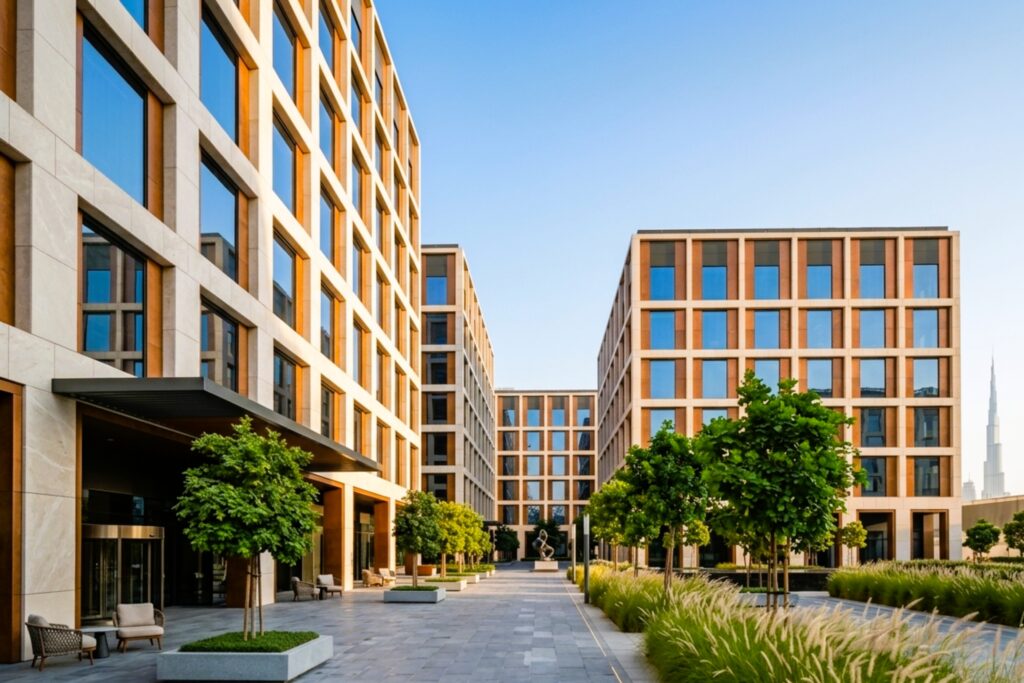
Dubai Hills Business Park – PARKLEX PRODEMA
A Subtle Shift Toward Smarter Specification
In recent discussions across the industry, there is a growing recognition that façade performance begins with informed specification.
Architects are asking more nuanced questions:
- How does this system behave under GCC climate conditions?
- What testing supports long-term durability, not just compliance?
- How does installation methodology impact performance?
- What happens when this façade ages?
These questions signal a shift from product selection to performance-driven design thinking.
Looking Ahead: Façades as Long-Term Assets
As Dubai continues to evolve architecturally, façades will play an even more critical role—not just in defining aesthetics, but in shaping building performance, safety, and value.
Ongoing façade damage is not simply a technical issue; it is a reminder that design decisions carry long-term consequences.
For architects, the opportunity lies in moving beyond minimum standards and embracing a more rigorous, informed approach to façade design—one that integrates regulation, material science, and real-world performance.
Continuing the Conversation
If you are currently designing a façade in Dubai or the GCC, now is the time to reassess:
- Are your specifications aligned with local climate realities?
- Are your details designed for long-term performance?
- Are you building for approval—or durability?
At Obras, we work closely with architects to refine façade strategies through material expertise, system thinking, and technical insight.
Explore our façade solutions or visit our showroom to experience materials in real conditions.